_TAG_2026.webp?width=1500&height=215&name=PSYMPL_LOGO_(R)_TAG_2026.webp "PSYMPL_LOGO_(R)_TAG_2026")













Table of contents

.svg)

The standard software for bank customer segmentation does little more than tell financial institutions who their customers are and provides little deeper insight. Age, account balances, and location of residence can compose a nice profile, but they don’t tell you why one customer opens every email and another unsubscribes after the first offer.
A 2025 peer-reviewed study on bank customer segmentation recorded a 16.08 percent revenue growth rate and a 4.5 percent increase in customer engagement after a bank applied an improved segmentation algorithm to real account data, but most customer segmentation software available to banks today doesn't reach that level of rigor.
This guide walks through what customer segmentation software actually needs to do for a bank or credit union:
- Which segmentation models are worth building around
- What to check before selecting a platform
- Where Psychographic AI™ closes the gap that demographic and behavioral data leave open
Psympl® works from a proprietary Motivation Intelligence™ framework built specifically for regulated financial services, so the segmentation strategies below are grounded in what banks can realistically implement, not theoretical best practices.
By the end, you'll have:
- A practical way to evaluate segmentation software
- A model for picking the right approach for your customer base
- A clearer picture of how AI-driven segmentation is reshaping customer experience in banking
7 Impacts of Customer Segmentation in Banking Your P&L Can't Afford to Miss

Customer segmentation in banking touches far more of the P&L than most teams initially map out, from acquisition costs to the price of running a branch network. The real benefits extend even wider, and they compound for both the bank and the customer.
1. Lower Customer Acquisition Costs
Segmentation lets marketing teams target prospects who already resemble a bank's best customers instead of buying broad, expensive reach. That precision also shortens the path from first contact to funded account, turning lower acquisition costs into faster acquisition as well.
2. Higher Cross-Sell and Upsell Conversion
When offers match a customer segment's actual financial priorities, conversion rates climb because the product genuinely fits the moment. Generic cross-sell campaigns waste impressions on customers who were never going to respond to that particular offer.
3. Reduced Customer Churn
Segmentation surfaces early behavioral and attitudinal signals, like declining engagement or a shift in product usage, before a customer decides to leave. Acting on those signals with a relevant retention offer keeps more relationships intact than a generic win-back campaign.
4. Increased Customer Lifetime Value
Customers who receive relevant offers and communication tend to consolidate more accounts and products with a single institution over time. That deeper relationship compounds into meaningfully higher lifetime value per household than a one-size-fits-all approach produces.
5. Sharper Marketing Spend Efficiency
Every dollar spent on a segment that was never going to convert is a dollar not spent on one that would have. Segmentation redirects budget toward the customer groups most likely to respond, improving marketing efficiency without necessarily increasing total spend.
6. Faster Time-to-Offer
Well-defined segments let marketing and product teams build campaigns against a known audience instead of starting research from scratch each time. That head start compresses the time between spotting an opportunity and getting a relevant offer to the right customer group.
7. Lower Branch and Contact Center Costs
Segmentation identifies which customers are comfortable self-serving through digital channels and which genuinely need in-person or phone support. Routing each group accordingly frees staff to focus on interactions that actually require a human, which tends to raise customer satisfaction along the way.
Which Of These 6 Segmentation Models Fit Your Bank? (& How to Pick)
No singular model of segmentation can meet every need across your entire organization, nor is every model perfect to be implemented immediately upon building a segmentation model. Which model to start with depends more on what data you already have on hand.
Once you’ve identified which model is best to begin, you can modularly add additional models along the way as your needs grow.
|
Segmentation Model |
What It Reveals |
Data You Likely Already Have |
Best Use Case |
Bank Readiness |
Required Governance |
|
Demographic |
Who the customer is |
Core account & KYC data |
Broad eligibility, product fit |
Easy |
ECOA / Reg B fair lending review |
|
Geographic |
Where they bank and live |
Branch, ZIP, address data |
Local campaigns, branch strategy |
Easy |
CRA & redlining compliance review |
|
Behavioral |
What they actually do |
Transaction & product usage history |
Churn prediction, cross-sell timing |
Moderate |
UDAAP review & model risk validation |
|
Needs-Based |
What problem they're solving |
Support logs, product inquiries |
Product development, service design |
Moderate |
Vulnerable customer & suitability review |
|
Technographic |
How they engage digitally |
App and digital channel usage data |
Channel strategy, digital product design |
Moderate |
Digital equity & accessibility review |
|
Psychographic |
Why they decide the way they do |
Survey data or a validated typing tool |
Messaging wording and tone, advisor matching, personalization |
Advanced (without data enrichment) |
Model validation, bias testing, legal sign-off |
5 Things Banks Should Look For in a Segmentation Platform: Customer Data Checklist
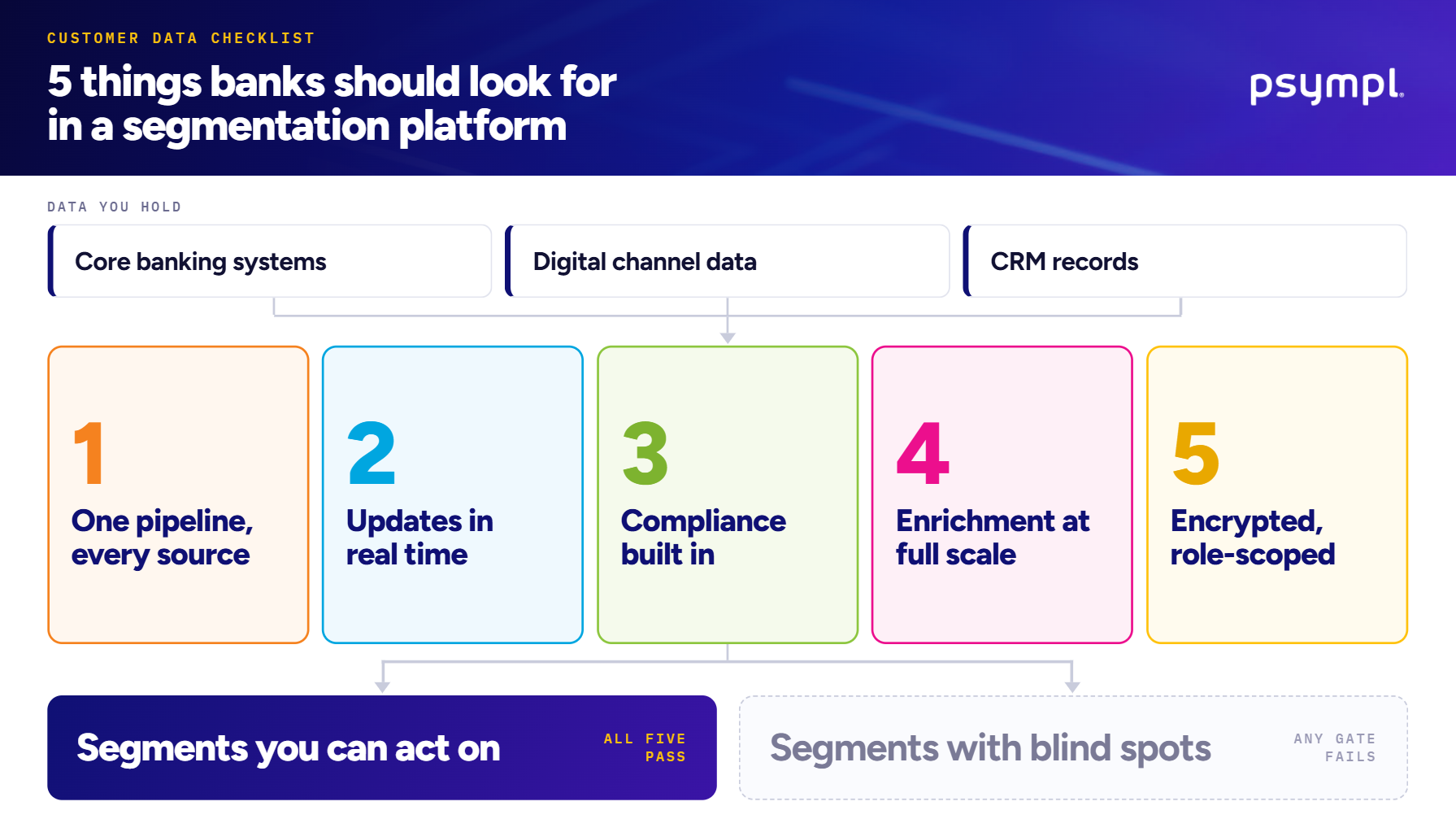
Once you’ve identified which models of segmentation you want to employ, you’ll have to locate a software or service to aggregate the data you have into something comprehensible. However, not all software is qualified to handle the magnitude of data or personal sensitivity of the details in a financial institution.
To that end, this list provides the criteria by which any reputable customer segmentation software should be judged.
1. Data Source Compatibility
A segmentation platform needs to pull from core banking systems, digital channel data, and CRM records without requiring a separate integration project for each source. If a platform can only ingest one type of customer data, its segments will always be missing key data points.
2. Real-Time Segment Updating
Customer behavior changes quickly, and a segment that only refreshes quarterly is already outdated by the time a campaign launches. Look for software that updates segment assignments as new transactions and interactions come in, not on a fixed batch schedule.
3. Regulatory Compliance Infrastructure
Segmentation software used in banking needs built-in safeguards for fair lending, data privacy, and consumer protection requirements, not compliance bolted on after the fact. Ask vendors directly how their platform supports disparate impact testing and documentation for regulatory exams.
4. Enrichment and Scalability
A platform should be able to enrich existing customer records with additional data, like psychographic or technographic attributes, without requiring every customer to complete a new survey. Scalability also means the software can handle enrichment across a full customer base, not just a small sample.
5. Data Security and Access Controls
Segmentation data often includes sensitive financial and behavioral information, so encryption at rest and in transit should be standard, not a premium add-on. Role-based access controls also matter, since not every team needs visibility into every customer segment.
From Static Lists to Live Segments: A Bank's Path to Psychographic AI™

For an example of how a bank can benefit from psychographics, let's examine a hypothetical regional bank that assembles demographic data from its core databases. Over time, their marketing department begins to report that their segments feel stale by the time campaigns launch. Also, cross-sell offers keep landing on customers who already own the product being pitched, proving that the segments no longer reflect real customer needs.
This particular bank has clean transaction history and a CRM, but no primary research on customer motivation. Rather than commissioning a multi-year study, it licenses a validated psychographic typing tool and layers it onto its existing behavioral segments, so no new customer survey is required for the base of the file.
Activation runs through the bank's existing email and app messaging platforms, with segment assignments refreshing as new transactions come in. Legal and compliance review the model for disparate impact before launch and set a quarterly bias check as a standing guardrail.
The model layers those motivational signals over the bank's existing behavioral data to flag life-stage triggers (e.g. a new job, a relocation, an unusually large but irregular payment) that predict what a customer needs next.
With that insight, the bank builds segments its marketing team can actually target. Risk-averse customers get money-management programs, and customers looking to invest get pointed toward opportunities.
Tired of Segmentation Software That Only Describes Your Customers at a Superficial Level? Meet Motivation Intelligence™
Segmentation strategies that don’t account for intent are leaving you halfway to the finish line and calling it a win. Psympl's Motivation Intelligence™ framework adds that missing layer that you need to drive real engagement and meet your customers where they’re at.
The result is segmentation that explains behavior instead of just cataloging it, giving marketing and product teams a real basis for personalization. Reach out now to see how Motivation Intelligence™ works with the customer data your bank already has.
Inside Psympl's 6 Segmentation Tools for Smarter Segmentation and Personalization

Segmentation and personalization only work together when the underlying tools are built to talk to each other, from classification through content creation. Here's what each of Psympl's six segmentation tools does and where it fits in that process.
1. Motivation Decoder™
Motivation Decoder™ is Psympl's core psychographic survey, built to classify a customer or prospect's motivational segment in under two minutes. The tool has been shown to predict a person's psychographic segment with Experian®, giving marketers a fast, reliable read even without prior behavioral data.
2. Motivation Auto-Decoder™
Motivation Auto-Decoder™ removes the survey step entirely, using a lookalike model built with Experian® data to assign psychographic segments across an entire CRM or prospect list. This is what makes psychographic segmentation possible at true enterprise scale, without requiring every customer to opt into a survey.
3. Consumer Console™
Consumer Console™ houses the underlying market research behind each psychographic segment, including communication preferences, financial attitudes, and behavioral triggers that shape rich customer profiles. It also includes geo-targeting and heatmapping functions, so teams can locate concentrations of specific segments across a market footprint.
4. Psymplifier™
Psymplifier™ generates motivation-aligned content, from emails and text messages to call scripts and marketing copy, tuned to each psychographic segment automatically. That turns segmentation insight into deployable content instead of a static research report that sits unused.
Importantly, the Psymplifier™ does not replace a bank’s existing investments in CRM or MarTech; the Psymplifier integrates with and enhances these technologies to amplify results.
5. Psymplifier™ Extension
Psymplifier™ Extension evaluates existing website or campaign copy through a psychographic lens and rewrites it with segment-aligned messaging in real time. It's built for teams that already have content in the market and want to sharpen it rather than start over.
6. Sales Extension
Sales Extension applies psychographic insight directly to individual contact records, giving frontline and advisory staff a motivational read on the person they're about to call. That context helps relationship managers tailor the conversation itself, not just the marketing that led up to it.
How AI in Segmentation Amplifies Personal Banking Insight at Every Touchpoint
The inclusion of an AI tool accelerates the speed at which behavioral and psychographic signals can be segmented in online or mobile banking. Rather than waiting for a regular reporting cycle, an AI is able to read decisions in real time and promote relevant offers straight to the customer.
That immediacy drives customer satisfaction gains inside digital banking experiences. Customers notice when a bank's app seems to understand what they're trying to accomplish, and that sense of being understood builds engagement over time in a way generic, scheduled campaigns rarely do.
These benefits are amplified by Psychographic AI™, which digs deeper into the drivers of customer behavior entirely autonomously, showing you why your customers are engaging with their services of choice. That insight lets banks tailor tone and content to match a customer's underlying motivation from moment to moment, starting at onboarding and continuing through long-term account management.
9 Steps to Segmenting Bank Customers With Software That Sticks

It doesn't matter how ingenious your segmentation strategy is if the software fumbles the moment it turns on. These nine steps are crafted to help you make sure that your segmentation software is properly optimized and operational from the moment it’s activated to years down the line:
1. Audit Your Existing Customer Data
Before evaluating any software, catalog what customer data already exists across core banking, CRM, and digital channel systems, and note where it's incomplete or siloed. Segmentation software can only work with the data a bank actually feeds it.
2. Define Clear Business Objectives
Segmentation built without a specific business goal, like reducing churn in a particular segment or increasing product penetration, tends to produce interesting research that never gets used. Anchor the project to a measurable outcome before selecting a model or a vendor.
3. Select a Segmentation Model
Match the segmentation model to the objective and the data on hand or easily accessible rather than defaulting to whichever approach sounds most advanced. A bank chasing churn reduction and a bank chasing wallet share growth may reasonably land on different models.
4. Generate Segment-Specific Content With AI
Once segments are defined, Psychographic AI™ can generate messaging, from email copy to call scripts, that speaks to each segment's underlying motivations rather than a generic value proposition. This is where segmentation stops being a research exercise and starts producing content teams can actually send.
5. Choose the Right Software Partner
Vet vendors specifically for compliance infrastructure, data security, and experience working inside regulated financial services, not just feature lists. A platform built for general retail marketing rarely holds up under a bank's fair lending and data privacy requirements.
6. Run a Focused Pilot Segment
Start with a single, well-defined segment and a specific campaign rather than trying to activate the entire customer base at once. A focused pilot surfaces problems with data quality or messaging early, while the stakes and the cleanup are still small.
7. Build Segment Engagement Guides
Document what messaging, channel, and tone work for each segment so the insight doesn't live only in one analyst's head. Engagement guides give marketing, product, and frontline teams a shared reference for how to actually talk to each customer group.
8. Train Teams to Act on Segment Insights
Segmentation data only changes outcomes when the people using it, from marketers to branch staff, understand what a segment assignment means and how to apply it. Without training, even the most accurate segmentation model ends up sitting unused in a dashboard.
9. Measure Results and Refine
Track the specific KPI the segmentation project was built to move, whether that's churn, customer retention, cross-sell conversion, or acquisition cost, and revisit the model regularly. Segments that stop producing results should be refined or retired, not kept out of habit.
10 Questions Financial Teams Ask Before They Buy Segmentation Software
Financial teams evaluating segmentation software tend to ask a consistent set of practical questions before signing a contract. The answers below address what typically comes up during that evaluation.
1. Is Segmentation Software Different From a CRM?
Yes. A CRM stores and manages customer records, while segmentation software analyzes those records to group customers by shared characteristics, motivations, or behaviors, and the two typically integrate rather than replace each other.
2. Can Smaller Banks and Credit Unions Afford It?
Segmentation scales to the size of the institution, and smaller banks with a well-defined customer base can often start with a focused pilot rather than an enterprise-wide rollout. Third-party platforms have also made psychographic and behavioral segmentation accessible without the cost of proprietary research.
3. Does It Require a Data Science Team to Run?
Most modern segmentation platforms are built for marketing and analytics teams to operate directly, without requiring an in-house data science function. That said, having some analytics capacity in-house makes it easier to interpret and act on the results.
4. How Does It Handle Multiple Product Lines?
Effective segmentation software can layer product usage and eligibility data on top of core segments, so a single customer segment can still receive different offers across a bank's full range of financial products, from checking to lending to investments. This keeps messaging relevant without requiring a separate segmentation model per product line.
5. What Happens to Segments When Behavior Changes?
Customers may move between behavioral segments as their behavior and circumstances change, and software with real-time updating should reflect that shift automatically. Platforms that only refresh on a quarterly or annual cycle will lag behind actual customer behavior. Psychographics focus on consumers’ intrinsic motivations and “financial personalities” (e.g., risk tolerance, financial goals, priorities), and a good psychographic segmentation model should remain relatively stable over time.
6. Is It the Same as Marketing Automation Software?
No. Marketing automation software executes campaigns and manages send schedules, while segmentation software determines who belongs in which group and why, and the two are usually meant to work together rather than substitute for each other.
7. Can It Integrate With Our Core Banking System?
Most segmentation platforms built for financial services offer integrations with common core banking and CRM systems, though the depth of that integration varies by vendor. Confirm specific compatibility with your core provider before selecting a platform.
8. Rules-Based vs. AI-Based: What's the Difference?
Rules-based segmentation sorts customers using fixed criteria set manually, like account balance thresholds, while AI-based segmentation identifies patterns and groupings the human team may not have specified in advance. AI-based approaches also tend to update more dynamically as new data comes in.
9. How Is Segmentation Software Priced?
Pricing models vary and can include per-record fees, tiered subscription pricing based on customer base size, or enterprise licensing for full-scale deployment. Ask vendors directly how enrichment, additional data sources, and support are priced, since these often sit outside the base subscription.
10. What Happens to Existing Customer Data During Migration?
Reputable segmentation platforms map and migrate existing customer records into the new system, rather than requiring a bank to rebuild its customer base from scratch. The vendor should provide a clear data-mapping and validation process upfront, following all privacy and data security requirements, so nothing gets lost or miscategorized when historical records move from a legacy CRM or core system into the new platform.
See What Bank Customer Segmentation Looks Like With Motivation Intelligence™

If your segmentation software isn’t telling you more than just your customers’ names and contact information, then it’s a glorified spreadsheet. Psympl's Motivation Intelligence™ platform combines demographic, behavioral, and psychographic data into a single view built specifically for banks and credit unions.
The result is segmentation that holds up under regulatory scrutiny while still giving marketing and product teams something they can actually act on. Psympl's suite of segmentation tools is built to plug into what a bank already has, from core banking data to an existing CRM.
Contact us to see how Motivation Intelligence™ works with your customer data and where it fits into your current segmentation strategy. We'll walk through what a rollout could realistically look like for your specific customer base.

Brent N Walker
Table of contents