_TAG_2026.webp?width=1500&height=215&name=PSYMPL_LOGO_(R)_TAG_2026.webp "PSYMPL_LOGO_(R)_TAG_2026")











Table of contents

.svg)

According to a survey conducted by Twillo Segment’s 2024 State of Personalization report, an analysis of over 500 businesses across several industries found that 72% of companies had adopted a customer analysis platform of some kind to streamline their personalization. To this end, most teams start their search for customer segmentation software by comparing feature checklists, and most teams end up disappointed within a matter of months.
No matter what features a piece of software offers, from real-time dashboards to AI-powered segmentation tools, it doesn’t mean a thing if that software can’t tell you why a customer stuck around or walked away.
That gap exists because most customer segmentation tools stop at behavioral and demographic data. They tell you what a customer did, not what motivated the decision, which means all you have is a record of the past, not a plan for the future.
This guide covers how a customer segmentation tool functions, the advantages a dedicated platform offers over spreadsheets and disconnected CRM fields, and the factors that separate software that merely works from software that moves the needle. It also covers the segmentation styles available today and where psychographic data fits into the right customer segmentation strategy for financial services organizations.
How a Customer Segmentation Tool Actually Works, From Raw Data to Reliable Segments
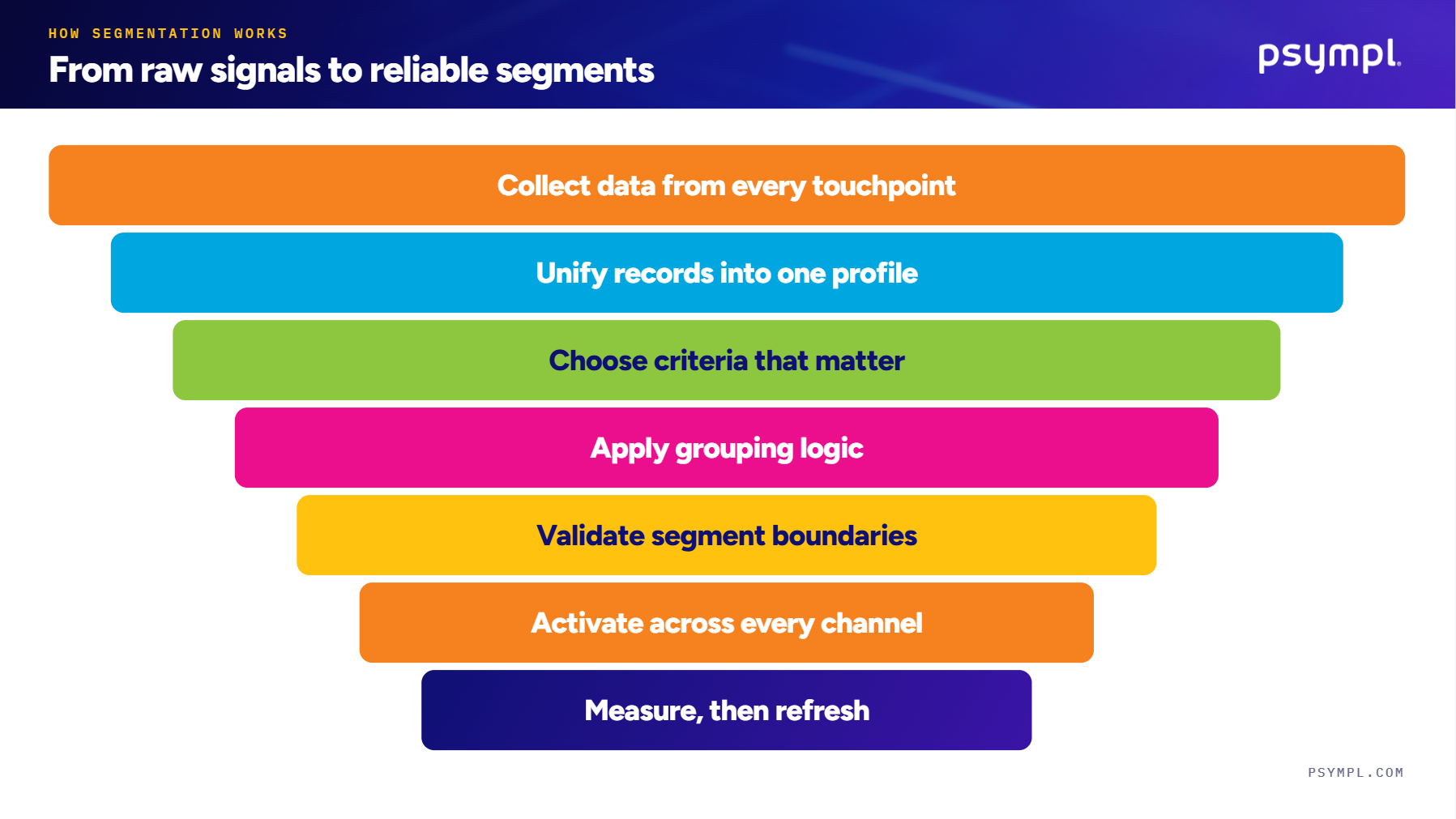
While the strategies of a specific service may vary as widely as the customers they’re examining, a customer segmentation tool aggregates data in a consistent fashion regardless of where it’s applied. The following is the standard process that a customer segmentation tool uses to turn your data into actionable insights.
1. Collecting Customer Data From Every Touchpoint
Segmentation starts with pulling in customer data from your CRM, website, app, and support interactions. The more complete the picture, the more accurate the customer profile that results.
2. Unifying Records Into a Single Customer Profile
Raw data from multiple systems needs to be matched and deduplicated into one unified customer record. Platforms like Twilio Segment specialize in this step, though many segmentation tools handle unification natively.
3. Selecting the Segmentation Criteria That Matter
Not every data point deserves equal weight in your segmentation strategy. Teams need to choose criteria, whether behavioral, demographic, or psychographic, that actually predict the outcomes they're trying to influence.
4. Applying Rules-Based or AI-Driven Grouping Logic
Rules-based logic sorts customers against fixed thresholds a team sets manually, like "balance over $10,000" or "logged in within 30 days." AI-driven logic finds patterns a human wouldn't have thought to define upfront, and it updates those groupings as new data arrives.
5. Validating and Refining Segment Boundaries
New segments need to be checked for internal consistency and reviewed against real customer behavior. Segments that are too broad or too narrow get adjusted before they're activated.
6. Activating Segments Across Campaigns and Channels
Segments only create value once they're deployed. This involves technical integration with your CRM and marketing platform, but it also requires organizational alignment, since insights need to reach marketing, customer service, and advisor-level interactions consistently.
7. Measuring Results and Setting a Refresh Cadence
Segmentation isn't a one-time project, since customer behavior and market conditions shift over time. Tracking segment performance against KPIs like retention and conversion tells you when a refresh is due.
8 Ways Dedicated Customer Segmentation Software Yields Sharper Customer Insight

Separating customer data into categories is the easy part of the process and any customer service platform should be able to handle that at the minimum, but dedicated customer segmentation software can handle much more intricate operations. Purpose-built tools convert scattered data into correlated information ready for strategies to be built around it.
1. Real-Time Visibility Into Behavioral Shifts
Dedicated platforms flag changes in customer behavior as they happen instead of during a monthly report. That immediacy lets teams intervene before a customer disengages or churns.
2. Unified Customer Profiles Across Every Channel
Rather than piecing together data from separate systems, a dedicated tool unifies customer data into one profile automatically. This gives every team the same complete view of each customer.
3. Automated Segment Updates as New Data Arrives
Segments built in dedicated software recalculate as new data comes in, rather than sitting static until someone manually rebuilds them. Customers move between segments as their behavior actually changes.
4. Predictive Scoring for Churn and Lifetime Value
AI-driven segmentation software can score customers on the likelihood of churn or their projected lifetime value. That foresight helps teams prioritize outreach toward the customers who need it most.
5. Faster Personalization at Campaign Scale
With segments ready to activate, marketing automation can personalize campaigns without a manual list-building process for every send. This shortens the distance between an insight and a live campaign.
6. Shared Segment Definitions Across Teams
A dedicated platform gives marketing, sales, and service teams one consistent definition of each segment. That consistency prevents departments from working off conflicting versions of who a customer actually is.
7. Less Manual Spreadsheet Work, More Strategy
Teams spend far less time exporting, cleaning, and merging spreadsheets when segmentation software handles those steps automatically. That time gets redirected toward interpreting insight and building segment-specific strategy.
8. Measurable Lift in Engagement and Retention
Because segments are more accurate and easier to activate, campaigns built around them tend to show clearer results. According to BCG's Personalization Index, brands that lead in personalization grow revenue 10 percentage points faster annually than those that lag, and also report higher customer satisfaction scores.
7 Factors That Separate Software That Suffices From Software That Succeeds
There’s no shortage of platforms advertising for customer segmentation services, but there’s a difference between a platform that offers it and a platform that specializes in it. The following table will help you tell whether your chosen platform will continue to perform as you scale or fall by the wayside.
|
Factor |
Where "Suffices" Software Falls Short |
Where "Succeeds" Software Delivers |
|
Segmentation Depth |
Stops at demographic and behavioral data |
Layers in psychographic and motivational data |
|
Real-Time vs. Batch Processing |
Refreshes segments on a delayed schedule |
Updates segments as new data arrives |
|
CRM and Data Stack Integration |
Requires manual exports and workarounds |
Connects natively to existing systems |
|
Data Security and Compliance |
Offers generic, unverified compliance claims |
Meets regulatory standards specific to financial services |
|
Scalability Across Customer Volume |
Slows or breaks down at higher record counts |
Performs consistently from thousands to millions of records |
|
Activation and Campaign Readiness |
Produces segments that live only in a report |
Pushes segments directly into messaging and campaigns |
|
Support and Onboarding Model |
Leaves teams to self-serve through documentation |
Provides hands-on guidance through setup and beyond |
Still Guessing Why Customers Convert? Let's Show You the Missing Layer
Still don't have an answer to the "why" behind your customer interactions? Looking for data you can really benefit from rather than more points to plot on a chart? Psympl's Psychographic AI™ brings the hard hitting insights on every customer, whether they convert or walk away.
If your current segments describe customers without predicting their motivations, it may be time for a different approach. Reach out now to see how Motivation Intelligence™ fits into your existing segmentation strategy.
The 6 Styles of Segmentation & Which Work For Your Customers
While we specialize in psychographics, there is no one strategy that encompasses all aspects of the buyer journey. Each of the following six strategies has their part in your customer segmentation strategy and wielding them together with efficiency is the key to the most effective plan.
|
Segmentation Style |
What It Groups Customers By |
Best For |
Watch For |
|
Demographic |
Age, income, marital status, education |
Broad audience targeting, eligibility rules |
Two customers with identical profiles can behave completely differently |
|
Geographic |
Location, region, branch proximity |
Local campaigns, market expansion |
Limited insight into attitudes or motivation |
|
Behavioral |
Purchase history, product usage, engagement |
Lifecycle marketing, churn prediction |
Explains what customers do, not why |
|
Values, attitudes, motivations, risk tolerance |
Personalization, messaging tone, advisor matching, relevance, addresses personal priorities |
Requires more sophisticated data collection than demographics |
|
|
Firmographic |
Company size, industry, revenue |
B2B account targeting |
Doesn't scale the same way B2C psychographic data does |
|
Technographic |
Device type, digital adoption, channel behavior |
Digital banking and fintech engagement |
Shifts quickly and needs frequent refreshing |
The AI Layer Most Segmentation Tools Miss: Personalized Customer Insight at Scale

As AI has become assimilated into most software in the customer segmentation space, its most popular use case is automated grouping, churn optimization, and emailing automation. This is a significant improvement to efficiency, but AI alone can’t perform the important analyses. It has to be pointed in the right direction and attached to the appropriate data sets to make a real impact.
Behavioral AI can tell you that a customer browsed three times without purchasing. It can't tell you whether that hesitation comes from a need for reassurance, a preference for independent research, or simple price sensitivity, and those three customers likely need three different messages.
Psychographic AI™ closes that gap by classifying customers according to validated motivational segments rather than inferred behavior alone. Instead of guessing at intent from clicks and page views, teams get a direct read on what drives a specific customer's decisions.
For consumer financial services organizations especially, where trust and risk tolerance shape nearly every decision, this distinction determines whether personalization actually lands or falls flat.
How These 6 Psympl® Products Fuel Stronger Customer Segmentation
Psympl® approaches customer segmentation as a connected system rather than a single tool, with each product handling a different stage of the process. Together, they take a customer from an unclassified record to a fully activated psychographic segment.
1. Motivation Decoder™: The Psychographic Survey That Types Any Customer
The Motivation Decoder™ is a validated typing tool built from Psympl's Ipsos-based market research, classifying any consumer into a motivational segment with 90% accuracy. It requires only a targeted subset of attitudinal questions rather than a lengthy survey.
2. Motivation Auto-Decoder™: Scaling Psychographic Segments Across Your Full Database
Built with Experian®, the Motivation Auto-Decoder™ projects psychographic segments across a financial institution's existing customer and prospect database without requiring a survey. This scales psychographic segment assignment to populations of any size for B2C targets.
3. Consumer Console™: Insights and Geotargeting by Motivational Segment
Consumer Console™ turns segment assignments into geographic and strategic insight, helping teams see where each motivational segment concentrates. It also provides market research-based insights regarding psychographic segments’ attitudes, priorities, channel preferences, and desired role of financial advisors. That visibility supports branch-level and market-level planning, not just individual outreach.
4. Psymplifier™: Messaging and Campaigns Built for Each Segment
Psymplifier™ generates messaging, campaigns, and customer journeys tailored to each psychographic segment's communication style. It removes the manual work of writing separate creative for every audience group.
5. Psymplifier™ Extension: Evaluating Existing Copy Against Every Segment
The Psymplifier™ Extension reviews existing website or campaign copy directly in the browser and flags where messaging misses the mark for a given psychographic segment. It then rewrites that content in real time to align with the segment's motivations, rather than requiring teams to draft new copy from scratch.
6. Sales Extension: Psychographic Context Inside Every Contact Record
Psympl® Sales Extension adds psychographic contact records directly into a sales team's existing workflow. Advisors and reps see a customer's motivational profile alongside standard CRM fields, without switching tools.
Got Questions About How to Segment Customers? Start Here

When a team starts to branch out into multiple forms of segmentation, it raises a lot of questions about process and strategy. We’ve assembled this list of our most commonly received concerns from clients to help smooth any of that over.
1. What's the Difference Between Customer Segmentation and Market Segmentation?
Market segmentation divides a broader potential market to guide go-to-market strategy and product positioning. Customer segmentation focuses on an organization's existing or prospective customers, using data to personalize engagement and improve retention. Both use similar methods, but their scope and purpose differ.
2. How Many Segments Should a Growing Customer Base Have?
Most effective segmentation strategies land between three and seven distinct segments. Fewer becomes too broad to act on, while more than seven often exceeds what a team can realistically operationalize. The right number depends on how much genuine differentiation exists in your customer base.
3. How Often Should You Refresh Your Segmentation Model?
A full refresh is typically warranted at least annually, or sooner after a major shift in acquisition mix or market conditions. Behavioral and demographic segments tend to drift faster than psychographic ones, since psychographic models are grounded in more stable personality traits.
4. Why Doesn't Psychographic Segmentation Scale the Same Way for B2B Targets?
B2C psychographic segmentation can scale through partnerships like Psympl's work with Experian®, which matches consumers to psychographic segments using name and home address. Work addresses aren't tracked the same way, so no equivalent scalable match exists for B2B targets. Identifying a B2B target's psychographic profile currently requires a direct survey, which isn't always feasible at scale.
5. How Does Segmentation Improve Customer Retention Over Time?
Segmentation makes personalized retention outreach operationally possible at scale. When teams understand what each segment values and how they prefer to be contacted, they can design retention campaigns that actually resonate instead of generic, one-size-fits-all messaging.
6. What's the Minimum Amount of Data Needed to Start Segmenting?
A functional starting point only requires enough data to apply one segmentation variable reliably, often behavioral data pulled from a CRM or transaction history. Richer segmentation, particularly psychographic segmentation, requires either primary survey data or a validated typing tool.
7. How Do You Measure Whether a Segmentation Strategy Is Working?
The clearest measures are shifts in the KPIs segmentation was meant to improve, including conversion rate, engagement rate, and revenue per customer. A well-executed strategy should show measurable lift in at least one of these within the first campaign cycle.
8. Can Customer Segmentation Work Without a Full Research Study?
Yes, though the depth of insight depends on the approach. Behavioral and demographic segmentation can start with existing CRM data, while psychographic segmentation without a full study still requires a validated typing tool like the Motivation Decoder™ to classify customers accurately.
Such a study is resource-intensive, requiring significant investment in dollars, time, and employee capacity. This is why Psympl® offers a validated financial psychographic model that can be operationalized at scale.
9. What Role Does an Engagement Guide Play Alongside Your Segments?
An engagement guide translates each segment's profile into practical direction for the teams who interact with customers directly. It specifies which messages, channels, and framing work best for each segment, so segmentation doesn't stay confined to a research report.
Stop Settling for Surface-Level Segments: Find the Right Customer Segmentation Partner

Telling you what a customer bought, browsed, or clicked through is something any software, or even a self-service survey, could tell you, but if you’re looking for a way to look into the head of any prospective customer, you’ll need software that’s far more sophisticated
Psympl's Psychographic AI™ and Motivation Intelligence™ platform were built specifically to close that gap for consumer financial services organizations. With a validated psychographic framework, a deployable typing tool, automated segment-specific content generation, and segmentation-ready engagement guidance, Psympl® helps banks, credit unions, wealth managers, and insurers move past behavioral guesswork.
The result is a customer segmentation strategy grounded in actual motivation, not just observed action.
Contact us today to see how Psympl® can strengthen the segmentation strategy you already have in place.

Brent N Walker
Table of contents