_TAG_2026.webp?width=1500&height=215&name=PSYMPL_LOGO_(R)_TAG_2026.webp "PSYMPL_LOGO_(R)_TAG_2026")












Table of contents

.svg)
Marketing channels deliver the best results when businesses understand not just who their audience is, but why they make decisions. A psychographic marketing channel strategy combines psychological insights about consumer values, lifestyles, and motivations with strategic channel selection to create more resonant and effective campaigns across every touchpoint. This approach moves beyond basic demographic targeting to address the deeper drivers of consumer behavior.

Understanding psychographics in marketing helps companies craft messages that speak directly to customer beliefs and preferences. When applied to channel strategy, these insights reveal which platforms different audience segments prefer and how they engage with content in those spaces. A fitness brand might discover that one customer segment values community and responds best to Instagram, while another prioritizes expert knowledge and prefers email newsletters.
The challenge lies in maintaining consistent psychographic targeting while adapting messages for each channel's unique format and context. Businesses that master this balance can deliver personalized experiences that feel authentic rather than repetitive, building stronger connections with customers wherever they choose to engage.
Why Channel Context Matters for Personalization

Psychographic insights lose their power when marketers apply them uniformly across all channels. The same customer who engages deeply with long-form content on email may scroll past verbose messaging on mobile, regardless of how well that content aligns with their values or lifestyle.
Beyond Demographics and Behavioral Data
Demographics reveal who customers are, while behavioral data shows what they do. Neither captures the situational factors that shape how customers interact with different channels at different moments. A customer's psychographic profile remains constant, but their receptiveness to messaging shifts dramatically based on which channel they're using and why.
Understanding context matters as much as data when delivering personalized experiences. A value-conscious shopper might spend 20 minutes researching product details on a desktop during evening hours. That same person checks their phone during a work break expecting quick, scannable information.
Channel context includes factors like device type, time of day, location, and the customer's likely mindset when using that channel. LinkedIn engagement happens in a professional context where career-focused messaging resonates. Instagram interactions occur during leisure time when aspirational or entertaining content performs better.
Marketers who layer channel context onto psychographic segments can match both the message substance and its delivery format to the customer's current situation.
Why Content Must Change by Channel
Each channel serves different purposes in a customer's daily routine, which demands distinct messaging approaches even when targeting the same psychographic segment. Email allows for detailed storytelling and comprehensive product information. SMS requires concise, action-oriented messages that respect the intimate nature of text communication.
Social media channels fragment further by platform characteristics. Twitter users expect brief, timely updates. Pinterest users seek visual inspiration and practical ideas. A sustainability-minded customer might engage with a detailed blog post about eco-friendly manufacturing on one channel while responding to a quick tip about product recycling on another.
Marketing communications must adapt content and offers for each customer on each channel. The psychographic foundation remains consistent, but the expression of that understanding changes. A security-focused customer receives technical specifications via email, reassuring customer reviews via social proof on landing pages, and quick trust signals in display ads.
Tone and visual presentation also shift by channel. Professional networks demand formal language and clean layouts. Entertainment platforms allow playful copy and bold visuals. Matching these channel-specific expectations while maintaining psychographic relevance creates seamless personalized experiences.
Motivations and Messaging With Psychographics

Understanding what drives customer decisions allows marketers to craft messages that resonate with specific psychological profiles. Different audiences respond to distinct motivational triggers based on their relationship with security, autonomy, and uncertainty.
Security-Driven vs Growth-Driven Audiences
Security-driven consumers prioritize stability, protection, and guaranteed outcomes in their purchasing decisions. They respond to messaging that emphasizes proven track records, warranties, certifications, and risk mitigation. Marketing to this segment requires highlighting reliability metrics, customer testimonials from similar cautious buyers, and clear safety features.
Growth-driven audiences seek advancement, innovation, and competitive advantages. These consumers engage with forward-looking narratives about market opportunities, performance enhancements, and transformative results. Their messaging should focus on potential gains, exclusive access to emerging solutions, and quantifiable improvements.
Key messaging differences:
- Security-focused: "Protect your investment with our 10-year guarantee"
- Growth-focused: "Unlock 40% faster results with cutting-edge technology"
Financial services often segment customers using psychographic dimensions like values and motivations to determine whether they prioritize capital preservation or aggressive returns.
Advisor-Reliant vs Self-Directed Consumers
Advisor-reliant consumers value expert guidance and prefer brands that offer consultation, customer support, and educational resources. They engage with content that demonstrates thought leadership, provides step-by-step guidance, and offers personalized recommendations. These buyers appreciate white-glove service, detailed product comparisons prepared by specialists, and ongoing relationship management.
Self-directed consumers research independently and prefer autonomy in their decision-making process. They engage with technical specifications, comparison tools, user reviews, and DIY resources. Marketing channels for this segment should emphasize transparent information access, customization options, and user control.
These psychographic characteristics shape consumer behavior differently than demographic factors alone. Brands must match their support infrastructure to audience preferences—whether that means robust live chat and consultation services or comprehensive self-service portals.
Risk-Averse vs Risk-Seeking Mindsets
Risk-averse consumers require extensive proof before committing to purchases. They engage with detailed case studies, long-form reviews, free trials, and money-back guarantees. Messaging should emphasize low-commitment entry points, extensive testing periods, and transparent return policies. These buyers typically have longer consideration cycles and require multiple touchpoints.
Risk-seeking consumers make faster decisions and respond to limited-time offers, early-adopter positioning, and bold claims. They engage with innovative product launches, beta programs, and exclusive opportunities. Their shorter decision cycles allow for more aggressive calls-to-action and urgency-based messaging.
Understanding these motivations behind purchases enables marketers to develop channel strategies that align message intensity with audience psychology. A risk-averse segment might receive nurture sequences spanning weeks, while risk-seeking audiences convert through immediate, high-energy campaigns.
Adapting Psychographics for Email Marketing
Email delivers psychographic precision that broadcast channels cannot match. Segmented messaging based on personality traits, values, and decision-making patterns allows marketers to send different versions of the same campaign to audiences who think differently, ensuring each segment receives copy calibrated to how they process information and make decisions.
Why Email Is Ideal for Deeper Personalization
Email infrastructure supports the level of segmentation psychographic marketing requires. A single campaign can deploy five versions, each written for a different personality profile, without the coordination overhead of running separate landing pages or ad sets.
Most marketing automation platforms allow segmentation by custom fields. Teams can tag contacts with psychographic segment labels, then trigger message variants based on those attributes. A high-Conscientiousness segment receives copy heavy on data and process. A high-Openness segment receives the same offer framed around insight and implication.
This capability matters because psychographic segmentation divides customers based on psychological characteristics, not just behavior or demographics. Two subscribers with identical job titles and identical engagement histories may require completely different messaging structures to convert. Email lets marketers address that difference at scale without fragmenting the campaign into unmanageable pieces.
Messaging Strategies by Psychographic Type
Each personality dimension requires specific messaging adjustments. High-Conscientiousness audiences need subject lines that signal specifics, not abstraction. "3 metrics we tracked across 400 accounts" outperforms "Transform your reporting strategy" with this segment.
High-Agreeableness subscribers respond to peer validation and team outcomes. Email copy should include phrases like "teams similar to yours" and "your colleagues will appreciate" rather than purely individual ROI framing. Social proof elements—case studies, testimonials, adoption numbers from comparable companies—carry more weight than independent analysis.
High-Neuroticism segments need risk mitigation built into every call to action. Free trials, money-back guarantees, and explicit exit language reduce anxiety. Low-Neuroticism subscribers find excessive hedging patronizing and prefer bold, direct positioning.
Understanding motivations based on beliefs, values, lifestyle, and interests enables this level of personalized messaging. The same product, same offer, different psychological entry point.
Best Practices for Psychographic Email Campaigns
Start with a baseline audit. Score existing email templates against your primary audience segments to identify which personality dimensions receive weak coverage. Most B2B campaigns over-index on Conscientiousness and under-serve Agreeableness and Openness.
Build variant templates, not one-off messages. Create reusable structures for each major psychographic segment so every campaign deploys with personality-appropriate framing from the start. A template library with five psychographic versions prevents the scenario where teams default to writing for only one personality type.
Test dimensional coverage, not just subject lines. A/B tests typically compare two subject lines for the same body copy. Psychographic testing compares messages calibrated to different personality profiles. Track which segments convert better with concept-first framing versus proof-first framing.
Tag and segment continuously. As subscribers engage with content, their behavior reveals psychographic signals. Someone who downloads detailed implementation guides and ignores vision pieces likely scores high on Conscientiousness. Someone who clicks peer case studies but skips analytical reports likely scores high on Agreeableness. These behavioral signals refine psychographic tags over time, improving targeting accuracy without requiring surveys.
Social Media Strategy Through Psychographics
Social media platforms reveal psychological traits through user behavior, content preferences, and engagement patterns. Brands can leverage these insights to craft messages that resonate with specific values, lifestyles, and motivations rather than relying solely on demographic targeting.
Social Media Is About Identity and Emotional Alignment
Social media behavior uncovers psychographic clues by revealing what users care about through their interactions, shares, and follows. Users curate their online presence to reflect their identity, making these platforms rich sources of psychographic data.
The content someone engages with signals their values and interests. A user who shares environmental content and follows sustainability advocates likely prioritizes eco-consciousness. Another who engages with productivity tools and entrepreneurial content demonstrates achievement-oriented values.
Emotional triggers drive social media engagement more than rational appeals. Marketing messages that align with a user's self-concept and aspirations generate stronger responses. A fitness brand targeting empowerment-seeking audiences will outperform generic health messaging when it speaks to personal transformation and community belonging.
Authenticity matters because users detect misalignment between brand messaging and their own values. Companies must identify the emotional drivers behind their audience's social media presence and mirror those motivations in their content strategy.
Channel-Specific Social Messaging
Different platforms attract distinct psychographic profiles that require tailored approaches. Instagram users often value aesthetics, visual storytelling, and lifestyle aspirations. LinkedIn attracts career-focused professionals who prioritize industry knowledge and professional development.
Platform psychographic profiles:
- Instagram: Visual learners, lifestyle seekers, aesthetic appreciators
- LinkedIn: Achievement-oriented professionals, knowledge seekers, networkers
- TikTok: Entertainment seekers, trend adopters, community participants
- Facebook: Community-focused users, information sharers, group participants
- Twitter/X: News consumers, opinion leaders, real-time information seekers
Each platform requires different content formats and messaging styles. A tech-savvy fitness segment responds well to innovation-focused content on Instagram showing smart equipment features. Holistic wellness seekers on the same platform prefer mindfulness-centered imagery and natural product showcases.
The same product demands different positioning across channels based on who uses each platform and why they're there.
Psychographic Social Media Best Practices
Collecting psychographic data through social media starts with monitoring key words and topics, analyzing engagement patterns, and tracking content preferences. Social listening tools identify sentiment, recurring themes, and emotional responses that reveal deeper motivations.
Marketers should segment audiences based on shared psychological traits rather than just demographics. Someone might target adventure-seeking Millennials differently from security-focused Millennials within the same age bracket.
Key implementation steps:
- Monitor social conversations to identify values and interests
- Track engagement metrics by content type and theme
- Create audience segments based on lifestyle patterns
- Test messaging variations across psychographic groups
- Refine targeting based on response data
Testing remains essential because psychographic segmentation requires validation through actual performance data. A brand might hypothesize that their audience values sustainability, but engagement metrics reveal stronger responses to convenience messaging.
Privacy considerations demand transparency in data collection. Brands must obtain proper consent and use psychographic insights responsibly without making assumptions based on stereotypes.
Utilizing Psychographics in Paid Advertising
Paid advertising demands immediate relevance because audiences scroll quickly and competition for attention intensifies by the second. Psychographic targeting transforms generic ad spend into precise emotional connections by aligning creative messaging, platform selection, and bidding strategies with underlying consumer motivations.
Why Paid Media Requires Faster Emotional Precision
Paid channels operate in high-friction environments where users encounter hundreds of competing messages daily. A demographic-only approach wastes budget by showing identical ads to people with completely different values.
Psychographic segmentation reveals why consumers behave the way they do, enabling advertisers to craft hooks that resonate within the first two seconds of exposure. Status-driven buyers respond to exclusivity cues. Value-conscious segments prioritize practical benefits. Adventure seekers engage with experiential storytelling.
Platforms like Facebook and Google allow layering of interest-based targeting with behavioral signals. Combining "outdoor enthusiasts" with "recent camping gear searches" creates a psychographic-behavioral intersection that dramatically improves conversion rates. Testing ad variations against specific psychographic traits identifies which emotional triggers perform best before scaling spend.
Ad Messaging by Psychographic Motivation
Effective paid ads speak directly to core motivations rather than product features alone. A fitness brand targeting performance-oriented athletes emphasizes competitive edge and measurable results. The same brand reaching wellness-focused consumers highlights balance, stress relief, and holistic health.
Key messaging frameworks by psychographic type:
- Innovators and early adopters: Cutting-edge features, beta access, first-mover advantage
- Status-conscious buyers: Prestige, exclusivity, social validation
- Eco-conscious consumers: Sustainability credentials, ethical sourcing, environmental impact
- Value-driven families: Cost savings, durability, practical benefits
Headline testing should isolate psychographic variables. Running "Save 40%" against "Join 10,000 satisfied customers" reveals whether price sensitivity or social proof drives a particular segment. Ad copy length also varies—detail-oriented personalities convert better with longer explanations while convenience seekers prefer concise benefit statements.
Creative and Media Placement Considerations
Visual style, tone, and platform choice must align with psychographic traits and lifestyle preferences. Adventure-oriented segments engage more with dynamic video content on Instagram and YouTube. Professional, achievement-focused audiences respond to LinkedIn carousel ads showcasing case studies and ROI metrics.
Creative elements signal psychographic alignment before users read a single word. Minimalist design attracts sophistication-seeking buyers. Bold, colorful visuals resonate with experiential, spontaneous personalities. User-generated content builds trust with community-driven segments while polished studio photography appeals to luxury-focused audiences.
Retargeting strategies should adjust messaging based on engagement depth. First-time visitors see awareness-stage content aligned with broad psychographic interests. Return visitors encounter motivation-specific offers that address identified values—whether that means limited-time exclusivity or detailed product comparisons depending on their segment profile.
Challenges of Omnichannel Messaging
Brands attempting to maintain consistent messaging across multiple channels face distinct obstacles that stem from audience preferences and behavior rather than technical limitations. Each platform demands contextual adaptation while preserving core brand identity, and failing to account for these nuances results in measurable performance losses.
Same Audience, Different Context
A customer browsing Instagram during their morning commute occupies a fundamentally different mental state than when they open their email inbox at work or scroll through Facebook before bed. The same person expects different content formats, tones, and engagement levels depending on the platform and time of day.
LinkedIn users respond to professional insights and data-driven content, while TikTok audiences expect entertainment-first messaging. Omnichannel marketing requires coordination across messaging and branding to maintain consistency without ignoring these contextual differences.
Platform-Specific Expectations:
- Email: Detailed information, special offers, longer reading time
- Social Media: Quick engagement, visual content, scrollable format
- In-Store: Immediate assistance, product demonstration, personal interaction
- Mobile Apps: Convenience features, location-based messaging, push notifications
Brands that send identical messages across channels ignore how purchase intent shifts based on context. A promotional email works differently than an Instagram story, even when targeting the same demographic segment.
The Cost of Generic Omnichannel Messaging
Generic messaging campaigns that treat all channels identically produce lower engagement rates and reduced conversion performance. When brands fail to adapt content for each platform, they waste advertising spend on audiences who receive irrelevant or poorly formatted communications.
Generic omnichannel approaches struggle with personalization and inconsistent messaging because they prioritize operational efficiency over customer experience. A customer who receives the same promotional message via email, text, and app notification within hours develops message fatigue and may unsubscribe from multiple channels simultaneously.
Budget allocation suffers when companies invest equally across channels without measuring platform-specific performance. Direct mail requires different creative assets and cost structures than digital advertising, yet many organizations force unified campaigns that underperform on both fronts.
The time investment needed to customize content for multiple channels often exceeds available resources. Marketing teams must balance message consistency with platform optimization, which requires bigger commitments in time and resources than single-channel approaches.
Building a Consistent Psychographic Approach Across Channels
A unified psychographic strategy requires systematic identification of audience segments, careful channel alignment based on psychological drivers, and creative adaptation that maintains brand coherence while speaking to specific motivations. Marketers can achieve this through structured segmentation, strategic channel mapping, and scalable personalization tools.
Step 1 — Identify Core Psychographic Segments
Businesses must begin by analyzing their customer base across five key psychographic domains: values, interests, attitudes, lifestyle, and personality traits. Research shows that psychographic variables including risk attitudes, cognitive ability, motivation, personality, and decision-making style serve as critical covariates for understanding multichannel customer behavior.
The segmentation process typically involves collecting data through surveys, social media analysis, purchase history, and behavioral tracking. Companies should focus on creating 3-6 distinct segments rather than dozens of micro-segments.
Each segment needs a clear profile that includes:
- Core values (security, achievement, autonomy, tradition)
- Lifestyle patterns (early adopters, bargain hunters, premium seekers)
- Decision-making preferences (analytical, impulsive, social-proof driven)
- Pain points and aspirations
Teams should validate these segments against actual purchasing behavior to ensure they represent meaningful distinctions in how customers engage with products and marketing messages.
While developing an effective psychographic segmentation model can be resource intensive in time, effort, and cost, Psympl collaborated with Ipsos to develop a validated financial psychographic model that can readily be employed by wealth management firms, banks, credit unions, fintech, and other financial services entities. This financial psychographic model is supported with extensive research data on channel preferences to maximize the likelihood of response.
Step 2 — Map Motivations to Channels
Different psychographic segments naturally gravitate toward specific channels based on the topic, their communication preferences, and information-seeking behaviors. Risk-averse customers often prefer detailed product pages and email communication, while experience-seekers engage more with social media and video content.
Marketers should create a motivation-to-channel matrix that outlines where each segment spends time and what they expect from each touchpoint. For instance, analytical decision-makers may research extensively on desktop before purchasing, while convenience-focused segments prefer mobile apps with one-click checkout.
Psympl market research focused on mapping channel preferences across various topics. Each financial psychographic segment has a channel matrix that guides optimal message delivery:
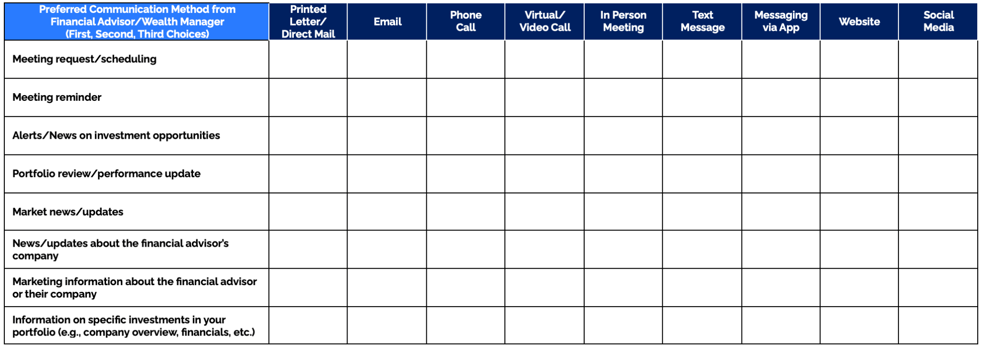
The implementation of targeted multi-channel campaigns requires tailoring the approach for different platforms while keeping messages consistent. This means adjusting format and tone without changing core value propositions.
Channel selection should also consider the customer journey stage. Status-conscious buyers might discover brands through Instagram but convert through personalized email sequences that reinforce exclusivity.
Step 3 — Adapt Creative Without Losing Brand Consistency
Creative execution must flex to match both channel requirements and psychographic preferences while maintaining recognizable brand elements. A luxury brand targeting achievement-oriented professionals might use aspirational imagery across all channels but adjust the context—LinkedIn content focuses on career success while Instagram highlights lifestyle rewards.
Visual and messaging consistency comes from maintaining core brand elements:
- Color palette and typography
- Tone of voice principles (not identical copy)
- Key value propositions
- Logo and design system
The adaptation happens in execution details. Security-focused segments respond to testimonials, certifications, and detailed specifications. Innovation-seekers engage with bold claims, product demos, and early access opportunities.
Brands should develop psychographic-specific creative frameworks rather than rigid templates. These frameworks define which emotional triggers, proof points, and calls-to-action resonate with each segment while allowing channel-appropriate formatting. A data-driven customer might receive a white paper download on LinkedIn and a comparison chart via email, both supporting the same product but tailored to context.
Step 4 — Use AI and Dynamic Personalization at Scale
Manual personalization across segments and channels becomes unsustainable as marketing complexity grows. AI-powered platforms enable brands to deliver psychographically relevant content to thousands of customers simultaneously through predictive algorithms and automated content selection.
Psychographic marketing can be transformed into a measurable system through machine learning models that analyze behavioral signals to infer psychological traits. These systems track which content types, messaging angles, and offers drive engagement for different personality profiles.
Dynamic content insertion allows marketers to maintain one campaign structure while automatically swapping creative elements based on recipient profiles. An email campaign might show different hero images, headlines, and product recommendations depending on whether the recipient scores high on openness, conscientiousness, or extroversion scales.
Real-time optimization adjusts channel mix and message frequency based on individual response patterns. If a customer segment shows higher engagement with Instagram Stories versus feed posts, the system automatically shifts budget allocation. Psychographic AI tools also identify when psychographic segments evolve, flagging shifts in preferences that require strategic adjustments.
Conclusion
Psychographic marketing channels strategy represents a fundamental shift in how businesses connect with their audiences. By focusing on psychological traits like values, lifestyles, and motivations, marketers can select and optimize channels that align with customer preferences and behaviors.
The implementation requires systematic data collection through surveys, social media analysis, and customer interviews if developing a psychographic model from scratch; however, Psympl offers a financial psychographic model for immediate implementation.Organizations must then match psychographic profiles to appropriate channels where their target segments naturally engage. A fitness brand targeting health-conscious millennials will achieve better results on Instagram and wellness podcasts than traditional media.
Success depends on three critical factors:
- Accurate psychographic profiling of target customers
- Strategic channel selection based on segment preferences
- Continuous testing and refinement of messaging and delivery
Research from multichannel customer behavior studies reveals that psychographic variables including risk attitudes, cognitive ability, and decision-making styles significantly influence channel choice and switching patterns. This data enables businesses to anticipate where customers prefer to interact and consume content.
The approach delivers more personalized experiences that resonate on an emotional level rather than relying solely on demographic assumptions. Brands that master psychographic channel strategies gain competitive advantages through higher engagement rates, improved conversion metrics, and stronger customer loyalty.
Marketing teams should integrate psychographic insights with existing demographic and behavioral data for comprehensive targeting. This combination creates robust strategies that address both who customers are and why they make purchasing decisions across different channels.
Ready to See Why Demographics Aren’t Enough?
Discover how psychographics are transforming personalized marketing and customer engagement across channels.

Access the Webinar: Demographics Aren’t Enough Anymore Webinar On-Demand

Brent N Walker
Table of contents