_TAG_2026.webp?width=1500&height=215&name=PSYMPL_LOGO_(R)_TAG_2026.webp "PSYMPL_LOGO_(R)_TAG_2026")















Table of contents

.svg)

The audience intelligence market is an industry built on predictive analytics. Resonate built its reputation on turning behavioral signals into predictions about what a consumer does next. However, Resonate is only one of at least six platforms doing meaningfully different versions of that same job.
Some platforms lean on behavioral and transactional signals. Others, including Resonate, combine that behavioral layer with predictive modeling to anticipate what a consumer is likely to do next.
Resonate has built a reputation as a leading provider of predictive consumer intelligence, giving marketers access to a platform that is continuously updated from more than 30 billion daily behavioral signals, feeding an identity graph linked to 250 million individual-level U.S. consumer profiles.
A smaller set of providers, including Psympl®, focus specifically on the motivational layer behind consumer decisions, particularly for regulated industries like financial services where compliance and messaging accuracy carry real weight.
Teams researching Resonate competitors are usually trying to solve one of two problems:
1. Finding a platform with different strengths for their industry
2. Comparing options before signing a contract
This guide breaks down the top Resonate alternatives, what each one does well, and where the gaps show up in practice.
The 60-Second Compare: Resonate vs. the Field
Even if you’re looking for an alternative, sifting through the internet’s cacophony of competitors would likely take more time than it’s worth. To help with that, we’ve assembled a list of the six most compelling alternatives to Resonate across the criteria that actually affect a decision, from motivation-based insight to financial services fit.
How we evaluated these platforms: Each competitor was assessed against six criteria — motivation-based insight, real-time predictive data, financial-services fit, privacy-safe data practices, built-in media activation, and pricing transparency. This was done by using each vendor's public product pages, privacy/trust documentation, and pricing pages as of 08/25/2026. "Financial-services fit" specifically measures dedicated compliance workflow tooling for regulated communications, not simply whether a platform can be used by a financial-services client.
|
Competitor |
Motivation-Based Insight |
Real-Time Predictive Data |
Financial Services Fit |
Privacy-Safe Data |
Built-In Media Activation |
Transparent Pricing |
|
Resonate |
✓ |
✓ |
✓ |
✓ |
✓ |
✗ |
|
Quantcast |
✗ |
✓ |
✗ |
✓ |
✓ |
✓ |
|
Faraday |
✗ |
✓ |
✗ |
✗ |
✗ |
✗ |
|
Psympl® Psychographics |
✓ |
✓ |
✓ |
✓ |
✓ |
✗ |
|
Predactiv |
✗ |
✓ |
✗ |
✗ |
✗ |
✗ |
|
MotiveMetrics |
✗ |
✓ |
✗ |
✗ |
✓ |
✗ |
|
Surge.AI |
✗ |
✓ |
✗ |
✓ |
✗ |
✗ |
8 Insight Questions Every Buyer Should Ask Before They Choose an Audience Intelligence Platform
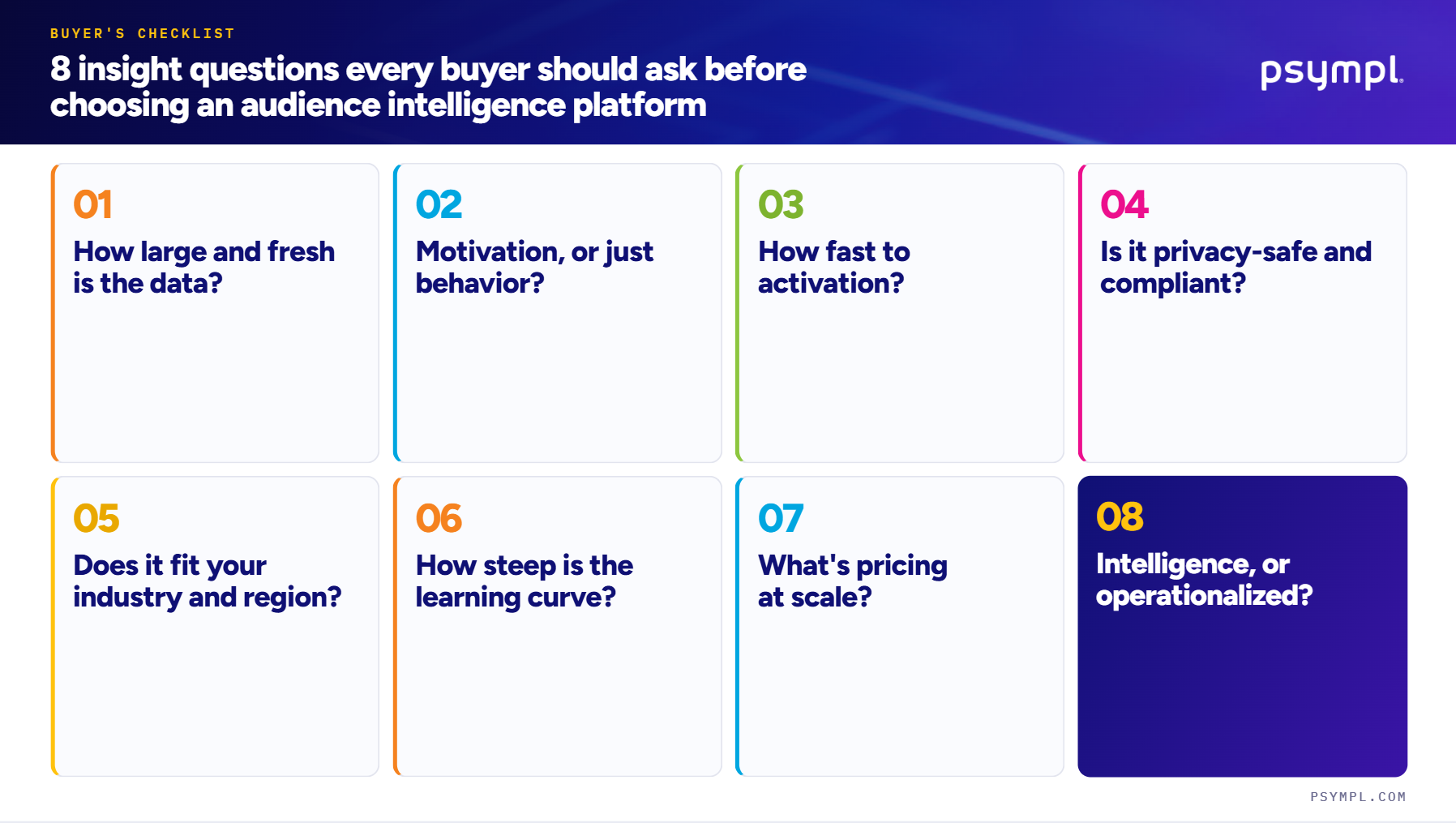
Before you’re able to read your customers, you have to know how to read your partners. In order to know if a service you’re considering is worth their salt, run down this list of questions to make sure they know their business:
1. How Large and Fresh Is the Underlying Data Set?
Data size matters less than how often it's refreshed and how directly it was collected from real individuals. A platform built on a stale panel or third-party aggregation will lag behind one with a large, regularly updated first-party base.
2. Does the Platform Explain Motivation or Just Behavior?
Behavioral data shows what someone clicked, bought, or browsed, but it doesn't explain why they made that decision. Platforms that surface motivation, not just activity, give marketing teams a foundation for messaging that actually connects.
3. How Fast Can Insights Move Into Activation?
Insight is only useful if it can be turned into a campaign, a segment, or a piece of content within a reasonable timeframe. Some platforms hand off raw data for another tool to activate, while others build activation directly into the workflow.
4. Is the Data Privacy-Safe and Compliant?
Consumer data regulations vary by state and industry, and financial services in particular carry additional compliance requirements. A platform's privacy practices should be verifiable, not just implied by a badge on the website.
5. Does It Cover Your Specific Industry or Region?
A platform with broad, one-size-fits-all coverage may lack the depth needed for a specific vertical like financial services, healthcare, or retail. Regional coverage matters too, since some providers are built primarily around US audiences.
6. How Steep Is the Learning Curve for Your Team?
A platform loaded with features is only valuable if the team using it can actually navigate them. Some tools require a dedicated analyst, while others are built for marketers without a data science background.
7. What Does Pricing Look Like at Scale?
Enterprise pricing structures can shift significantly as data volume, seat count, or campaign activation needs grow. It's worth asking for a scaling scenario upfront rather than discovering the real cost after signing a contract.
8. Is the platform simply intelligence or does it also operationalize those insights?
Some platforms stop at reporting, leaving teams to figure out how to apply the data to actual campaigns and content. Others, like Psympl®, connect psychographic insight directly to CRM integration and content personalization, closing the gap between knowing a customer's motivation and acting on it.
6 Top Resonate Competitors Worth Putting on Your Shortlist
In our examination of the market, these are the top six platforms that are most commonly contrasted with Resonate, each with their own strengths and weaknesses. As each one competes with Resonate in a different aspect, there is no perfect answer, but your ideal alternative is very likely located below:
Quantcast: AI-Powered Audience Prediction for the Open Web

|
Best fit |
Programmatic buyers who need to launch and optimize open-web ad campaigns in one platform |
|
Likely limitation |
Built for media buying and optimization, not deep motivation or psychographic profiling |
|
Financial-services caveat |
No compliance-specific tooling for regulated marketing communications |
|
When to consider it over Resonate |
When the priority is executing and optimizing programmatic buys, not building audience personas |
Quantcast built its reputation as a demand-side platform, giving advertisers a way to predict audience behavior and manage programmatic campaigns directly. It pairs well with a separate insights or persona tool since Quantcast is optimized for buying and activating media, not explaining why an audience behaves the way it does.
Faraday: Predictive Marketing Built on Data Science, Not Guesswork
|
Best fit |
Data science teams building custom predictive models on first-party data |
|
Likely limitation |
Requires more technical setup than an out-of-the-box insights platform |
|
Financial-services caveat |
Not purpose-built for regulated messaging or compliance review workflows |
|
When to consider it over Resonate |
When you need custom predictive modeling more than pre-built consumer intelligence |
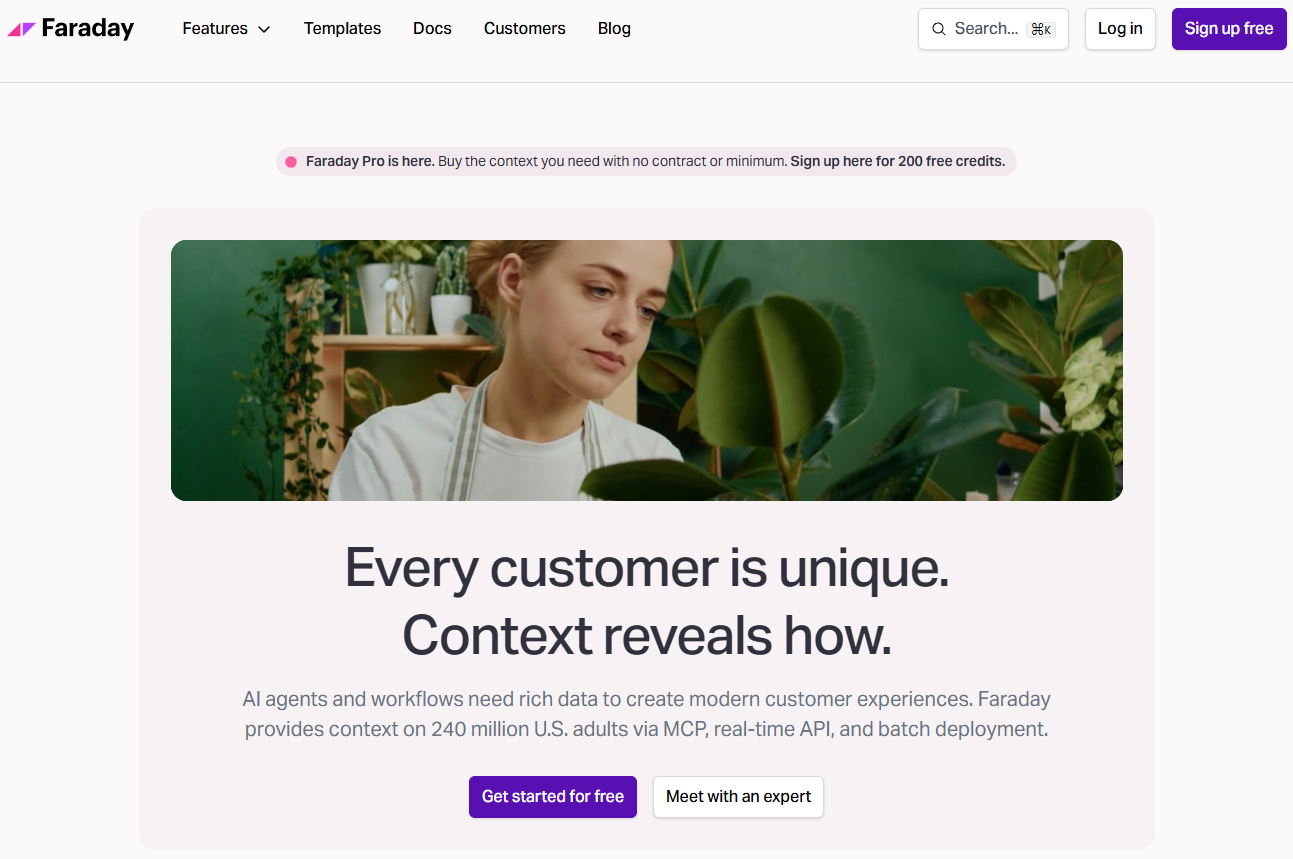
Faraday applies data science and machine learning to first-party data, helping brands predict customer behavior and personalize outreach at scale. The platform rewards teams with technical resources on staff, since building and maintaining custom predictive models takes more setup than a plug-and-play consumer intelligence tool.
Psympl®: Psychographics Built for Regulated Financial Services
|
Best fit |
Banks, credit unions, wealth managers, and insurers needing compliant, motivation-based messaging |
|
Likely limitation |
Narrower industry focus than horizontal, all-market consumer intelligence platforms |
|
Financial-services caveat |
Buyers outside financial services verticals should confirm fit before assuming coverage |
|
When to consider it over Resonate |
When compliance, motivation-based messaging, and financial services specificity matter more than broad market coverage |
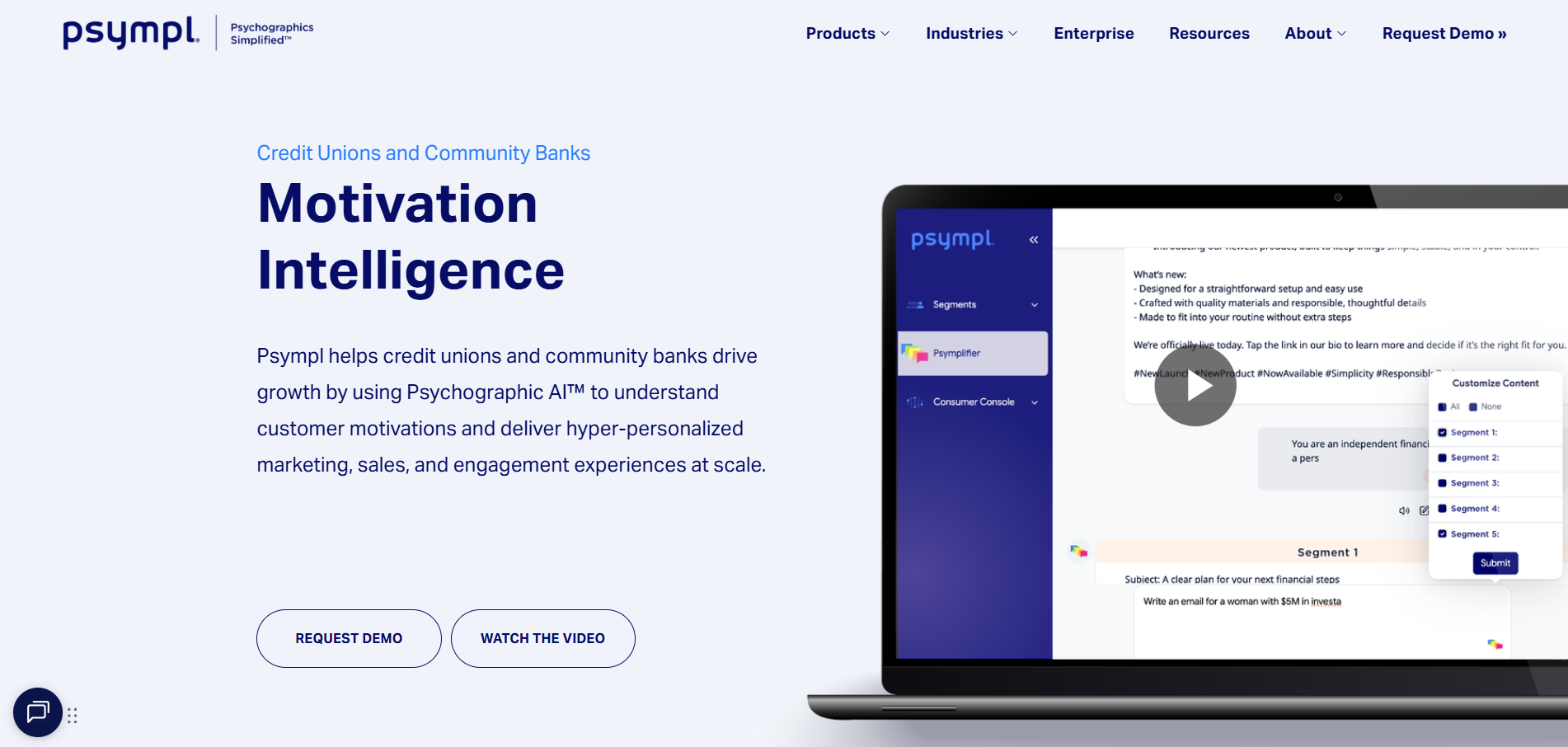
Psympl® is a Psychographic AI™ platform strategically designed for banks, credit unions, wealth management firms, and other regulated consumer financial services organizations. Rather than describing what a customer did, it identifies the underlying motivation behind financial decisions and applies that insight directly to messaging and campaign personalization.
Predactiv: Predictive Analytics for Brands Playing the Long Game
|
Best fit |
Brands using digital behavioral data to drive predictive engagement strategies |
|
Likely limitation |
Less emphasis on the values and motivation layer than psychographic-first platforms |
|
Financial-services caveat |
No dedicated compliance framework for regulated industries |
|
When to consider it over Resonate |
When digital engagement prediction matters more than deep persona-level insight |
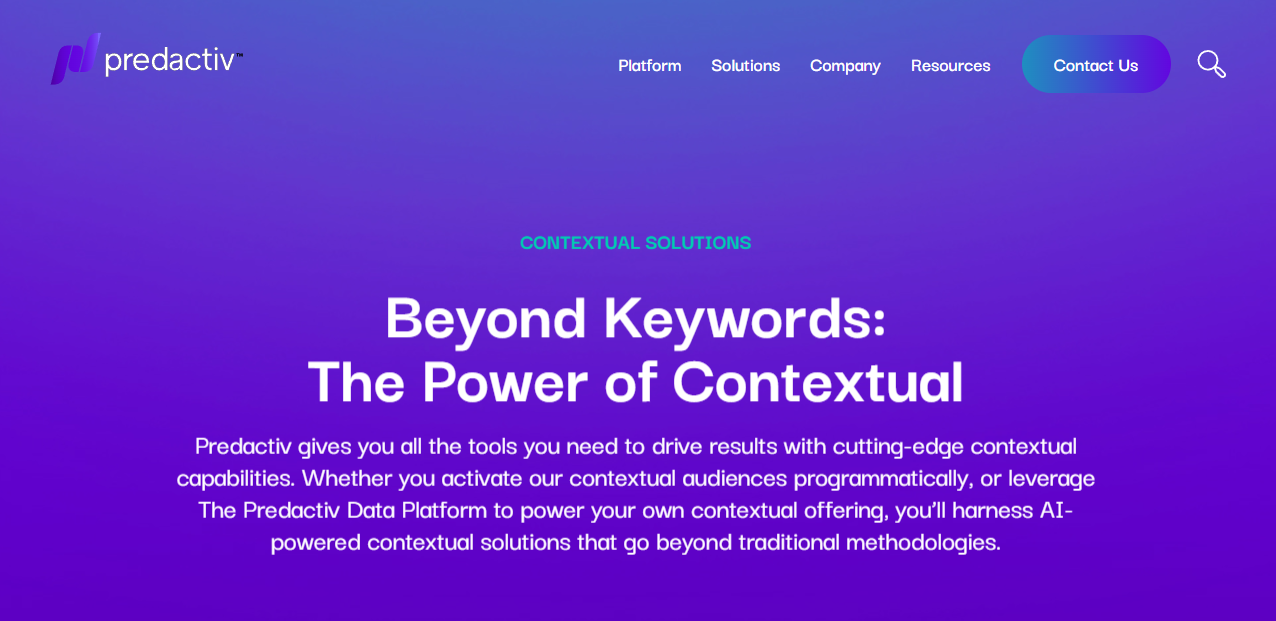
Predactiv focuses on digital data and predictive analytics to inform engagement strategy, helping brands anticipate customer needs over a longer relationship arc. It leans more toward behavioral and transactional signals than the values-based motivation layer that platforms like Psympl® or Resonate emphasize.
MotiveMetrics: Natural Language Processing for Smarter Ad Campaigns
|
Best fit |
Ad tech teams optimizing campaign copy and creative with AI and NLP |
|
Likely limitation |
Focused on ad performance, not full consumer intelligence or segmentation |
|
Financial-services caveat |
Not designed around financial services compliance requirements |
|
When to consider it over Resonate |
When the goal is AI-optimized ad creative and copy testing, not audience research |
MotiveMetrics uses AI, machine learning, and natural language processing to help ad tech teams optimize campaign copy and creative performance. It's a strong fit for teams focused specifically on ad performance testing rather than broader audience research or segmentation.
Surge.AI: Real-Time Market Intelligence Without a Single Cookie
|
Best fit |
Teams needing real-time, cookieless trend and market intelligence |
|
Likely limitation |
Broad trend signals rather than individual-level psychographic depth |
|
Financial-services caveat |
No stated compliance positioning for regulated industries |
|
When to consider it over Resonate |
When speed and cookieless data collection matter more than granular persona-level insight |
Surge.AI collects and analyzes data across the internet in real time, giving marketing and product teams trend intelligence without relying on cookies. That breadth comes at the cost of individual-level depth, since Surge.AI is built for spotting patterns at the market level rather than profiling specific consumers.
6 Ways Psychographics Outperform Demographic & Behavioral Data

Demographic and behavioral profiling is the baseline of all effective segmentation and analytical strategies, but their insight is limited to who they are and what they’ve done, leaving the deeper motivational analysis to you. Psychographic data automates this process. Utilizing psychographics, you can cut to the core of each customers’ decision making and better serve them exactly what they’re looking for.
1. Motivation Data Financial Brands Can Actually Act On
A demographic profile can describe a customer's age and income, but it can't explain whether they're driven by security, independence, or status. Psychographic data translates directly into messaging decisions, giving marketing teams a clear starting point instead of a guess.
2. Built for Regulated Industries From Day One
Many consumer intelligence platforms are built for a broad market and retrofitted for compliance later. Psympl® was designed specifically for banks, credit unions, wealth management firms, and insurers, so compliance considerations are part of the platform rather than an afterthought.
3. Messaging That Writes Itself From Psychographic Profiles
Once a psychographic profile identifies what a customer values, whether that's transparency, control, or long-term stability, campaign copy has a clear starting brief instead of a blank page. That shortens the distance between insight and execution for content and marketing teams.
4. Segments That Stay Stable Longer Than Behavioral Data
Behavioral data shifts constantly as a customer's transactions and browsing habits change week to week. Psychographic segments are built on values and attitudes, which tend to hold steady longer and don't require constant rebuilding.
5. A Platform Designed Around Financial Services Compliance
Where general-purpose platforms leave compliance review as a manual step layered on top of the tool, Psympl® keeps regulated messaging requirements in mind at the platform level. That reduces the back-and-forth between marketing and compliance teams before a campaign goes live.
7. Identifies Reason Rather Than Identity
Demographics answer who a customer is, and behavioral or transactional data answers what they've done, but neither gets at why they're likely to act. Psychographic data fills that specific gap, working alongside demographic and behavioral data rather than replacing it.
Your 9 Resonate Alternative FAQs, Answered Without the Sales Pitch

Wondering about the details of a platform transfer or the market itself? Here’s a handful of questions we often hear that can help clear up any lasting confusion:
1. How Long Does a Typical Platform Install Take?
Timelines depend heavily on data volume and how many systems need to connect to the new platform, but most enterprise switches take a few months from contract to full activation. Teams that scope out integration requirements early tend to move faster than those who start mapping systems after signing.
2. Why Don't These Vendors List Pricing Publicly?
Enterprise consumer intelligence platforms typically price based on data volume, user seats, and which modules a client activates, which makes a flat public rate impractical. Most vendors, including Resonate and its competitors, require a discovery call to scope pricing to actual usage.
3. Can You Run a Pilot Before Committing to a Contract?
Some platforms offer a limited pilot or proof of concept, though it's more common among newer or smaller providers than established enterprise platforms. It's worth asking directly, since pilot terms and data access vary significantly between vendors.
4. What Happens to Historical Data During a Migration?
Reputable platforms should offer an export process for historical segments, campaign data, and reporting before a contract ends. It's worth confirming data portability and retention terms before signing with any new provider, not after a switch is already underway.
5. Do Alternatives Integrate With Your Existing CRM and MarTech?
Most established platforms offer native integrations or APIs for common CRM and marketing automation tools, though the depth of that integration varies. It's worth testing the actual connection during a pilot or demo rather than relying on a vendor's integration list alone.
6. Is Consumer Intelligence Software Worth It for Small Teams?
Smaller teams can benefit from consumer intelligence tools, but platforms built for enterprise scale may include more complexity and cost than a smaller organization needs. It's worth matching platform scale to team size rather than defaulting to the most feature-rich option available.
7. How Do You Know When It's Time to Switch Providers?
Common signals include stagnant data freshness, a platform that hasn't kept pace with the team's industry needs, or a growing reliance on manual work to translate insights into campaigns. If a platform requires more workarounds than it used to, it's worth evaluating alternatives.
8. What Kind of Onboarding Support Should You Expect?
Onboarding support ranges from a self-serve knowledge base to a dedicated implementation team, depending on the vendor and contract tier. Enterprise-focused platforms, particularly those serving regulated industries, typically offer more hands-on onboarding given the added compliance considerations.
9. Can You Use More Than One Platform at the Same Time?
Yes, and many marketing teams already do, pairing a media activation platform like Quantcast with a deeper insights or psychographic tool for messaging strategy. The key is making sure the platforms complement each other instead of duplicating the same function.
Ready to Move Past Demographics? Let's Talk Psychographics

Resonate and its competitors each bring something different to the table, from programmatic media activation to predictive modeling to real-time trend data.
However, when you’re working closely with customers on an individual level, the insight that pays dividends is the insight that reveals motivations behind customer choices. Psympl® was built specifically to answer that question for banks, credit unions, wealth management firms, and other regulated consumer financial services organizations.
The Psympl® platform, including Motivation Decoder™ and Motivation Auto-Decoder™, connects psychographic insight directly to messaging and campaign personalization without asking teams to rebuild their existing MarTech stack. That means the gap between understanding a customer's motivation and acting on it stays small.
Reach out now to see how Motivation Intelligence™ applies to your organization's customer engagement strategy.

Ran Mullins
Table of contents