_TAG_2026.webp?width=1500&height=215&name=PSYMPL_LOGO_(R)_TAG_2026.webp "PSYMPL_LOGO_(R)_TAG_2026")















Table of contents

.svg)
The financial services industry faces an unprecedented challenge as an estimated $124 trillion transfers between generations through 2045. Traditional demographic targeting falls short when advisors discover that age and income brackets fail to predict which heirs will stay with inherited advisors versus seeking new relationships. Psychographic profiling reveals the values, communication preferences, and financial priorities that determine whether wealth transfer recipients remain loyal clients or move their assets elsewhere.

Understanding psychological drivers behind financial decisions transforms acquisition and retention approaches during the great wealth transfer. Silent Generation and Baby Boomer clients operate with different expectations than Gen X, Millennial, and Gen Z inheritors who prioritize digital access, transparent communication, and aligned values over long-standing family relationships with advisors. More than 70% of heirs change financial advisors after inheritance, making psychographic intelligence critical for firms positioning themselves to capture transferring assets.
Firms that map client segments by psychological characteristics rather than just basic demographics gain competitive advantages in both retaining existing multi-generational households and acquiring new wealthy clients. This approach examines how different generations make financial decisions, what communication channels they prefer, and which service models resonate with their expectations for advisor relationships.
Why Psychographics Power Modern Wealth Transfer Acquisition Strategies

Financial institutions face a fundamental challenge as assets shift between generations: traditional demographic segmentation cannot predict how heirs will make decisions, evaluate trust, or choose advisors. Psychographic intelligence addresses the behavioral and motivational factors that determine whether an institution retains inherited assets or loses them to competitors.
Why Demographics Alone Fail During Moments Of Inheritance And Asset Movement
Age and income brackets provide surface-level data but reveal nothing about how individuals perceive risk, process financial information, or form advisory relationships. Two 45-year-old heirs with identical net worth may exhibit completely different financial behaviors based on their underlying mindsets and values.
Research on the Great Wealth Transfer shows that more than 40% of advisor relationships turn over when assets pass to the next generation. This attrition occurs because firms assume generational cohorts share uniform preferences when in reality psychographic variation within any age group far exceeds differences between generations.
Gen X inheritors represent the most immediate inflection point for assets under management, yet this demographic displays the widest range of psychographic profiles. Some prioritize autonomy and direct control over investments while others seek collaborative guidance. Demographic data cannot distinguish between these opposing orientations.
Psychographics Reveal Motivations, Trust Drivers, Risk Orientation, And Decision Styles
Psychographic segmentation identifies the psychological factors that drive financial behavior. These include attitudes toward authority, preference for structure versus flexibility, tolerance for uncertainty, and what constitutes credible evidence when evaluating financial products.
A financial psychographic model developed through research conducted by Psympl with Ipsos identifies five distinct mindsets that exist across all wealth levels and generations. These segments differ fundamentally in how they want to interact with institutions, what communication styles resonate with them, and which value propositions motivate engagement.
Key psychographic dimensions include:
- Risk perception: How individuals interpret volatility and potential loss
- Guidance preference: Degree of advisor involvement desired in decision-making
- Value alignment: Importance of ESG factors, philanthropy, and legacy considerations
- Information processing: Preference for data-driven analysis versus narrative explanation
Understanding how psychographics influence financial decisions enables institutions to predict heir behavior with greater accuracy than demographic proxies allow. This precision matters most during inheritance events when relationship continuity hangs in the balance.
The Great Wealth Transfer Is Both A Retention Risk And A Client Acquisition Opportunity
Between $84 trillion and $124 trillion will transfer from Baby Boomers to spouses, children, grandchildren, and charities over the next two decades. Nearly half of financial advisors view this shift as an existential threat to their practice due to poor heir retention rates.
The same dynamic that creates retention risk generates acquisition opportunity. Heirs who disengage from their parents' advisors actively seek new relationships. Firms equipped with psychographic intelligence can identify and target these individuals with messaging that aligns with their specific motivations and decision-making styles.
Values-aligned investing preferences vary sharply by psychographic segment rather than generation. One heir profile prioritizes impact and ESG integration while another focuses exclusively on performance and tax efficiency. Generic "next generation" marketing fails to differentiate between these distinct audiences.
How Psychographic Intelligence Strengthens Wealth Transfer Acquisition Strategies At Scale
Psychographic communication strategies enable personalization that goes beyond surface-level customization. Instead of adjusting messaging based solely on age or asset level, institutions can tailor content, channel selection, and value propositions to match underlying psychological drivers.
Scalable psychographic segmentation requires systematic data collection and modeling infrastructure. Financial institutions can deploy assessment tools, analyze behavioral signals from digital interactions, and apply predictive algorithms to classify prospects and clients into psychographic categories.
Implementation components include:
- Psychographic assessments integrated into onboarding and relationship reviews
- Content libraries mapped to distinct mindset profiles
- Adaptive communication workflows that adjust messaging based on segment identification
- Performance measurement tracking engagement and conversion by psychographic segment
Modern wealth transfer retention strategies combine psychographic intelligence with multi-generational relationship management. Firms that understand how different heirs think about wealth—not just how much they inherit—can craft acquisition campaigns that resonate at the moment of decision.
Legacy Wealth Holders: Silent Generation & Baby Boomers

These two generations control the majority of transferable wealth and share distinct behavioral patterns shaped by economic stability, traditional financial values, and decades-long relationships with trusted advisors. Their decision-making centers on capital preservation, risk avoidance, and ensuring their wealth reaches intended beneficiaries intact.
Common Psychographic Patterns: Preservation-First, Trust In Advisors, Legacy Planning
The Silent Generation and Baby Boomers prioritize protecting what they've accumulated over aggressive growth. Baby Boomers are the wealthiest generation to have ever lived, benefiting from decades of mostly stable economic expansion during their prime earning years.
These clients typically maintain long-term relationships with financial advisors, often spanning 15-20 years or more. They view their advisor as a trusted partner rather than a service provider, which creates both opportunity and vulnerability during wealth transfer planning.
Legacy planning dominates their financial priorities in later years. They want assurance that children and grandchildren will receive their assets according to specific wishes. This generation shows higher engagement with estate planning tools like trusts, wills, and beneficiary designations than younger cohorts.
Key behavioral markers include:
- Low tolerance for portfolio volatility
- Preference for fixed-income securities and dividend-paying stocks
- Resistance to investment strategy changes without substantial justification
- Strong emotional attachment to certain holdings, particularly real estate
What "Security-Driven" Decision-Making Looks Like In Messaging And Service Models
Security-driven clients respond to messaging that emphasizes stability, proven track records, and risk mitigation. They want evidence that strategies have worked through multiple market cycles, not theoretical projections or innovative approaches.
Service models must demonstrate protective measures. Annual portfolio reviews should highlight downside protection strategies, tax efficiency improvements, and estate planning updates rather than performance relative to aggressive benchmarks.
These clients value consistent processes over novelty. Quarterly statements, annual face-to-face meetings, and predictable communication cadences create the reassurance they seek. Changes to established routines trigger anxiety rather than excitement.
Documentation matters significantly to this demographic. They expect detailed written summaries of meetings, clear explanations of recommended changes, and comprehensive estate planning documents that they can review with family members or attorneys.
Communication Preferences: Reassurance, Clarity, Relationship Continuity
Phone calls and in-person meetings remain the preferred communication channels for most Silent Generation and older Baby Boomer clients. Email serves as a secondary tool for sharing documents rather than primary correspondence.
They expect their advisor to initiate contact, not the reverse. Proactive outreach during market volatility or major life events reinforces the relationship and demonstrates attentiveness to their situation.
Language must avoid jargon and complexity. Terms like "alpha generation" or "alternative asset allocation" create confusion rather than confidence. Clear explanations using everyday language build trust more effectively than technical sophistication.
Relationship continuity concerns intensify as these clients age. They need to know who will serve them if their primary advisor retires and how the transition will occur. Introducing successor advisors years before a transition reduces anxiety and maintains account retention.
How To Protect AUM While Setting Up Downstream Wealth Transfer Acquisition Strategies
Multi-generational planning meetings create natural bridges to the next generation without threatening existing client relationships. Inviting adult children to annual reviews positions the advisory relationship as a family resource rather than exclusively serving the parents.
The approach requires explicit permission from the senior generation first. Advisors should frame these conversations around ensuring children understand their parents' wishes and financial structure, not as an effort to acquire new clients.
Effective implementation steps:
- Introduce the concept 3-5 years before anticipated wealth transfer events - Early conversations normalize the process
- Position heirs as co-learners initially - They attend meetings to understand family financial values and structures
- Create separate touchpoints with heirs - Brief educational sessions on topics like inheritance tax implications or managing concentrated positions
- Document the parents' legacy intentions - Written statements about values and wealth philosophy help heirs understand decision-making context
Advisors must demonstrate value to both generations simultaneously. While parents want preservation and legacy planning, their adult children often need guidance on student debt management, home purchases, or career transitions. Serving both sets of needs without compromising the primary client relationship requires careful balance.
Emerging Wealth Controllers: Gen X, Millennials, And Gen Z
The beneficiaries of the Great Wealth Transfer represent three distinct cohorts with divergent expectations, investment behaviors, and advisor relationship preferences. Gen X is poised to inherit a significant portion of boomer wealth alongside Millennials, while Gen Z is entering the picture as an emerging force in wealth accumulation and inheritance.
Gen X: The Most Immediate Inheritor Group—And The Most Psychographically Diverse
Gen X currently occupies a unique position as both active wealth accumulators and immediate inheritors. Over the next quarter-century, Gen X will receive $39 trillion in transferred assets, positioning them as critical targets for wealth management acquisition strategies.
This generation displays considerable psychographic diversity that complicates one-size-fits-all approaches. Gen X spans individuals who experienced the transition from analog to digital, creating a split between those who prefer traditional advisor relationships and those who embrace digital-first engagement. Some prioritize hands-on portfolio management while others seek delegated investment models.
Their career trajectories vary widely—from corporate stability to entrepreneurial ventures—resulting in different risk tolerances and liquidity needs. Gen X clients may simultaneously manage aging parent care, children's education expenses, and their own retirement planning. This sandwich generation status creates complex financial planning requirements that demand flexible, multi-generational service models.
Millennials & Gen Z: Digital Expectations, Transparency Needs, Values-Driven Choices
Millennials and Gen Z share fundamental characteristics that distinguish them from older cohorts. Millennials will inherit $45.6 trillion over the next 25 years, making them the largest beneficiary group.
Digital-first expectations define both generations' approach to wealth management:
- Seamless mobile access to accounts and documents
- Real-time portfolio updates and performance tracking
- Digital communication channels including text and video calls
- Integrated financial planning tools and calculators
Transparency has become non-negotiable for younger investors. They demand clear fee structures, straightforward communication about investment strategies, and honest discussions about performance. Hidden costs or complex fee arrangements trigger immediate distrust and prompt them to seek alternative advisors.
Values-driven investing represents a defining characteristic. Ownership of sustainable investments doubled from 12% to 26% among wealthy individuals between 2018 and recent surveys, with 73% of millennials using sustainable investments compared to 21% of older respondents. Nearly 50% of young investors hold cryptocurrency, reflecting their belief that traditional stocks and bonds alone cannot achieve above-average returns.
Key Differences In Confidence, Independence, And Guidance Preferences
Generational cohorts display distinct attitudes toward financial advice and self-directed management. Millennials often exhibit high financial confidence despite facing economic challenges including student debt and housing affordability issues. They actively seek multiple income streams and entrepreneurial opportunities, which translates to comfort with non-traditional asset classes.
Gen X typically demonstrates measured confidence balanced with recognition of expertise gaps. They acknowledge the value of professional guidance but expect collaborative relationships rather than directive advice. This generation appreciates advisors who explain rationale behind recommendations without patronizing simplification.
Gen Z shows the highest propensity for self-education through digital resources before engaging advisors. They desire active control over personal finances and view advisors as educators and validators rather than sole decision-makers. This generation expects advisors to provide context and tools that enable informed independent choices.
Independence preferences vary significantly:
- High touch needs: Complex estates, business succession, multi-generational planning
- Hybrid models: Digital tools for routine tasks, advisor access for strategic decisions
- Self-directed: Minimal intervention, platform access, educational content
Personalization Plays That Improve Conversion In Wealth Transfer Acquisition Strategies
Generic outreach fails with emerging wealth controllers who expect customized engagement. Effective personalization begins with segmentation beyond simple age brackets—incorporating life stage, wealth source, digital adoption level, and values alignment.
Communication channel preferences require customization. Gen X may respond to email and phone outreach while millennials prefer text messaging and social media engagement. Content format matters equally—Gen Z gravitates toward video explainers while Gen X may prefer written analysis.
Service model flexibility improves conversion rates significantly. Offering tiered engagement options allows prospects to select their preferred advisor interaction level. Some inheritors want comprehensive planning while others seek targeted guidance on specific wealth transfer decisions.
Financial education content serves as effective personalization—creating materials addressing each generation's knowledge gaps builds trust before formal engagement. Millennials respond to content about managing irregular income from entrepreneurial ventures, while Gen X values guidance on coordinating inherited assets with existing portfolios.
Technology integration demonstrates understanding of digital expectations. Firms that showcase their digital solutions and online access capabilities during prospecting conversations signal alignment with younger investors' operational preferences. This includes portfolio visualization tools, document sharing platforms, and integrated financial planning software that clients can access independently between advisor meetings.
Putting Psychographics Into Action For Retention + Acquisition
Financial institutions that deploy psychographic intelligence can personalize engagement at scale, address parent-heir mismatches proactively, and convert relationship continuity into measurable growth across multiple generations.
Why Generational Stereotypes Weaken Both Retention And Acquisition Performance
Some generalities have been discussed above, distinguishing between older and younger generations, but segmenting clients by generation alone assumes homogeneity within age cohorts that does not exist in practice. A 45-year-old Gen X inheritor may be risk-averse and hands-off, while another seeks active involvement and alternative investments. Treating both identically because they share a birth decade leads to misaligned messaging and disengagement.
Psychographic intelligence reveals five distinct financial mindsets that transcend age, wealth level, and even advisor relationships. These mindsets explain how individuals perceive risk, what they value, how much guidance they want, and what language motivates action.
|
|
Segment 1 I'm financially comfortable and I invest, but I'm hands-off with my investments. I want experts to guide my investments using a safe and predictable approach.
|
|
|
Segment 2 I'm financially secure and actively following the stock market and discussing finances. I favor a more aggressive approach, seeking the highest returns, and am interested in alternative investments like cryptocurrency.
|
|
|
Segment 3 I'm financially secure and confident in my financial standing and retirement. I'm comfortable making my own financial decisions, and prefer a balanced approach to risk, seeking both potential gains and security.
|
|
|
Segment 4 I'm living paycheck to paycheck and worried about my retirement. I avoid investing and often carry credit card debt because of my financial situation. I would appreciate assistance with my finances.
|
|
|
Segment 5 I believe I'm financially secure. I don't invest or trust the stock market but I have checking and savings accounts and I'm still on track for retirement. My finances aren't complex, so I prefer to just manage them myself. |





All five financial psychographic segments are represented in each generation, but the segment distribution varies across generations:
|
|
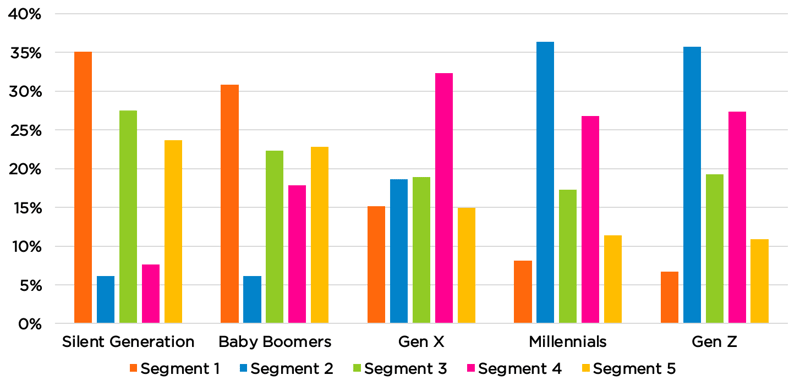
Each psychographic segment approaches finances and investing differently with different motivations and engagement preferences (message, channel mix).
Firms relying on demographic assumptions fail to address the actual drivers of decision-making. This becomes critical when more than 40% of heirs choose not to retain their parents' advisors. The disconnect stems not from generational preference but from psychographic mismatch between communication style, service delivery, and the heir's underlying financial orientation.
Segment-Aligned Messaging, Channels, And Cadence That Build Trust Faster
Psychographic segmentation enables advisors to match communication style, frequency, and channel preference to each client's decision-making framework. Some segments respond to data-driven analysis and detailed reports. Others prioritize values alignment and prefer conversational updates over formal presentations.
Channel preferences by psychographic profile:
- Analytical segments: Detailed quarterly reports, portfolio performance dashboards, scheduled calls
- Values-driven segments: Impact stories, philanthropic outcomes, informal check-ins
- Security-focused segments: Regular reassurance, proactive outreach, simplified summaries
- Independence-oriented segments: On-demand access, self-service tools, minimal contact unless requested
Cadence matters as much as content. Overengaging autonomy-seeking clients erodes trust, while underserving those who need frequent reassurance creates anxiety and attrition risk. Psychographic-based personalization allows firms to calibrate both message and delivery method to match how each client processes information and builds confidence.
Managing Parent–Heir Differences With Intentional Personalization
The parent-heir relationship often masks significant psychographic divergence. A parent comfortable with conservative portfolio management may raise an heir focused on ESG principles and active engagement. Without early identification of these differences, the transition becomes a breaking point rather than a continuity opportunity.
Advisors who map psychographic profiles across family units can address conflicts before assets transfer. This includes facilitating conversations about values, introducing heirs to different service models, and adjusting communication strategies to reflect both parties' preferences.
Intentional personalization means treating the heir relationship as distinct, not derivative. It requires separate discovery conversations, tailored engagement strategies, and demonstrable alignment with the heir's financial mindset—not an assumption that the existing approach will carry forward. Firms that implement multi-generational relationship management position themselves to retain assets and expand wallet share across transitions.
How Psympl Enables Scalable, Compliant Wealth Transfer Acquisition Strategies Across Teams
Psympl's psychographic intelligence platform applies financial mindset modeling at scale, allowing institutions to segment clients and prospects without manual profiling. The system identifies psychographic orientation through behavioral data, survey responses, and interaction patterns, then maps individuals to one of five core financial psychographic segments.
This enables advisors to deploy segment-specific messaging, customize service delivery, and prioritize outreach based on retention risk or acquisition opportunity. Teams can automate personalized communication workflows that adapt tone, content, and frequency to match each client's psychographic profile while maintaining compliance standards.
The platform supports both retention and acquisition strategies. For retention, it flags parent-heir mismatches and recommends engagement adjustments. For acquisition, it identifies prospects whose psychographic profiles align with the firm's strengths and tailors outreach accordingly. Scalable personalization powered by psychographic intelligence transforms relationship management from reactive service to proactive strategy across entire client bases.
Download the Whitepaper
The Great Wealth Transfer is already reshaping how assets move, relationships evolve, and trust is earned across generations. Firms that rely on age-based segmentation alone risk losing both assets and relevance.

Download Psympl’s executive whitepaper, The $124 Trillion Great Wealth Transfer: Psychographics Are the Key to Protecting and Growing AUM Across Generations, to learn how psychographic intelligence enables more precise personalization, stronger multi-generational relationships, and more effective wealth transfer acquisition strategies.

Brent N Walker
Table of contents