















Table of contents



In Celent and Temenos’ 2026 survey of 2,500 US consumers, 51% said their bank should better anticipate their needs when they open the app or call, yet only 4% of banks named personalizing the customer experience their top investment priority.
Many banks are responding to this need by leveraging AI customer experience personalization: the use of machine learning and generative AI to tailor what a bank says, offers, and does at every point where a customer meets it.
However, while LLM-optimized timing tells a bank when to reach a customer, it doesn't tell them why that customer decides the way they do. In response, FreeStar Financial Credit Union tested adding motivation as a measurement factor. In a Psympl and Experian case study, audiences scored by Psympl generated more than $1.2 million in new High Yield Savings deposits within 30 days among 8,000 prospects, while the traditional control group (n=2,000) generated no new accounts.
If you’re a bank/credit union marketing lead or CX leader wondering about the available personalization tech as AI continues to evolve, this guide is written for you. We’ll cover the top benefits and AI applications that make these styles of strategies work along with the compliance risks to settle before launch.
6 Benefits of AI Personalization in Banking That Raise Customer Value

In Celent and Temenos' survey, 75% of financial customers were only moderately satisfied or worse with their primary institution, and 62% of US banks say acquiring and engaging customers has gotten harder. The six benefits below show what AI personalization can change for that group.
1. Fewer, better-timed messages
In Adobe and Econsultancy’s 2025 research, 70% of financial services consumers expect brands to anticipate their needs at the right moment, and only 32% say that expectation is met. UXDA, a financial UX design firm, puts the discipline plainly: “Relevance is partly created through restraint.”
2. Stronger customer trust
Adobe and Econsultancy also found that 90% of financial services consumers rate responsible data handling as very important or critical, while only 58% feel their data is handled securely. As TD chief information officer Kiran Vuppu puts it, “Trust is the price of entry for AI in financial services.”
3. More relevant product offers
Celent principal banking analyst Michael Bernard says, “Consumer demand is shifting from access and convenience toward personalization, trust, and guidance.” FreeStar Financial’s mortgage applications rose 337% year over year after it targeted three psychographic Financial Mindsets, though the case study notes that comparison is not a controlled test.
4. Lower churn
Gartner research (distributed by Magnolia) reports that 34% of customers switch their primary financial provider to get a better website or mobile app. Churn models flag falling logins, shrinking balances, and reduced product use, and motivation guides whether the outreach offers guidance, a rate review, or a banker’s call.
5. Deeper primary-bank relationships
The same Gartner research, by analysts Jonathan Jackson, Van To, and Sophia Palmstedt, found customers are 5.14 times more willing to use generative AI tools when their bank personalizes experiences extremely well. FreeStar Financial extended its motivation layer from a savings campaign into mortgage marketing and online banking.
6. Lower cost to serve
In TD’s 2026 survey, nearly half of Americans were open to AI banking assistants that proactively help with tasks such as paying bills and setting alerts. Conversational AI that resolves those routine requests, reducing the cost of paying staff to deal with requests below their pay grade.
6 AI-Driven Applications That Turn Account Data Into Well-Timed Outreach
In KPMG's 2025 survey of 200 US banking executives, 182 ranked data-driven personalization and insight among their highest priorities for the following year. If you’re looking to utilize that same style of data, this table pairs each AI-driven application with what it does, where motivation adds precision, and the metric that shows whether it worked.
|
Application |
What It Does |
Where Motivation Adds Precision |
Outcome Metric |
|
Next-best-action decisioning |
Picks the most useful response, including no outreach |
Sets tone and framing of the action |
Offer acceptance and dismissal rates |
|
Churn-risk prediction |
Flags warning signs before a customer leaves |
Matches the retention message to the person |
Retention vs. a control group |
|
Personalized product recommendations and feature adoption |
Matches products and app features to usage and goals |
Chooses which benefit leads |
Products per customer and feature adoption |
|
Life-event guidance |
Spots life-stage signals and offers relevant help |
Sets detail level and how direct to be |
Engagement and opt-out rates |
|
Proactive cash-flow nudges |
Warns of a shortfall, with options |
Keeps the alert helpful, not alarming |
Overdraft incidence and alert action rate |
|
Conversational AI assistants |
Handles routine tasks and hands off with context |
Adjusts response style and depth |
Resolution rate and satisfaction |
The pattern in the third column holds for every row: motivation does not decide whether to reach out. It decides which benefit leads, how direct the message is, and what the next step looks like. That is why a bank can add it to an existing timing model without rebuilding the model.
Where to Start with AI Personalization in Banking: 9 Steps That are Small, Measurable, & Safe
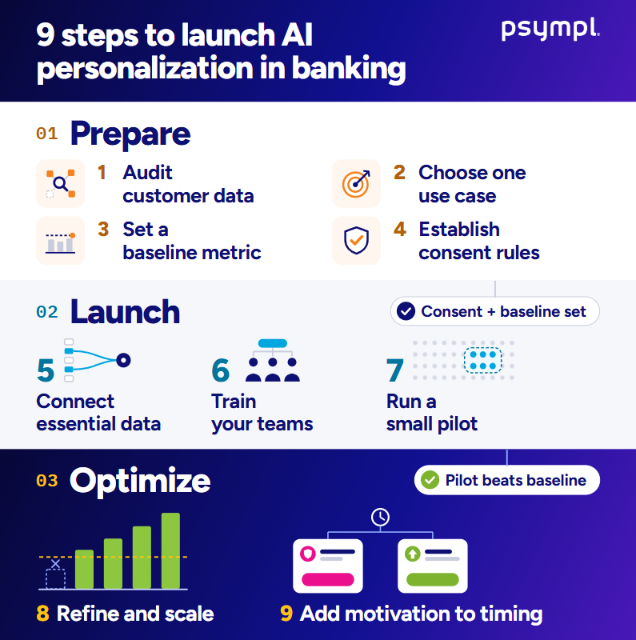
EY-Parthenon’s 2025 banking survey found that only 16% of generative AI use cases ever reach full deployment. To avoid the pitfalls of the 84%, these nine steps below keep scope small, measure from the first campaign, and put compliance review ahead of scale.
1. Audit your customer data
Catalog what sits in the core, CRM, digital banking, and contact center systems, and flag where records are siloed or out of date. Personalization can only use the customer data a bank can actually reach.
2. Choose one use case
Pick one application from the table above, such as churn-risk outreach for a single product line. A narrow scope keeps the results readable.
3. Set a baseline metric
Record today’s number for the outcome you want to move, such as offer acceptance, retention, products per customer, or customer lifetime value. Hold out a control group so any lift can be attributed to the change, and set the pass mark before launch.
4. Set consent and data-use rules
Document which data may be used, for which messages, and how a customer opts out. Have compliance and legal review the rules before any data reaches a model.
5. Connect only the data that use case needs
KPMG’s 2025 survey of 200 US banking executives found that data privacy and risk (93%), data quality (89%), and legacy integration (81%) are the main blockers to modernizing data. A pilot that connects only the data one use case needs depends on far less of that work.
6. Train marketing and frontline teams
Teach marketers, branch staff, and contact center agents what a segment or signal means and how to act on it. FreeStar’s rollout included executive, manager, and staff training, and it is expanding staff role-playing.
7. Run a small pilot
FreeStar Financial’s first campaign reached 10,000 prospects through one direct mail drop and geotargeted digital ads before it expanded. A pilot that size limits the cost of a wrong assumption and gives compliance a bounded program to review.
8. Review, refine, then scale
Compare results to the baseline, retire what did not work, and extend what did to more products, channels, and audiences. EY found that 40% of implemented generative AI use cases failed to meet expectations, so scale only what beats the baseline.
9. Layer motivation onto timing
Once the timing logic works, add a motivation intelligence layer so the same trigger produces different wording, framing, and next steps for different customers. FreeStar Financial followed that order, proving the offer in one campaign before extending motivation intelligence into mortgage marketing and online banking.
Time to See What Your Customer Data Is Missing?
Your systems are probably chock full of account data that shows you what a customer did and when they did it. However, if you want tech that’ll tell you why, Psympl’s Motivation Intelligence™ adds that layer to the segments, triggers, and CRM records a bank already has.
To see how Psychographic AI™ fits alongside your current personalization program, reach out a demo and see how your data can be elevated. We will walk through what a first campaign could look like for your customer base.
Context Tells You When, Motivation Tells You Why, Psympl Tells You How: AI Personalization With a Point of View

In contrast with other segmentation styles which group by behaviors or demographics, psychographic segmentation is the practice of grouping customers by their attitudes, values, and motivations. Psychographic insights allow you to understand why two customers with identical balances and transaction histories respond differently when presented with the same offer or opportunity.
Context tells a bank when a customer needs something. Motivation tells it why that customer decides the way they do.
NTT DATA’s 2021 study of 4,807 consumers found that 35% were willing to pay for and share personal data for personalized proactive services, a difference in attitude that a transaction record cannot show.
Psympl supplies the “how.” Psympl’s Psychographic AI™ platform for consumer financial services can autonomously identify a customer’s motivation segment and generate communication written for it. Its national research with Ipsos identified psychographic segments of financial consumers.
For example, in the event that a withdrawal would exceed a customer’s weekly balance, Psymplifier™ can write one automated alert that offers reassurance and a recommended fix and another that lays out the numbers and the options.
FreeStar Financial Chief Growth Officer Jennifer Martines attested in our case study that knowing what motivates a member “changes how we market, but it also changes how we lend, how we serve, and how we talk to people every day.”
The 6 Psympl® Tools Behind AI-Powered Customer Conversations That Feel Personal
Psympl’s proprietary technology involves the following six tools that cover the path from identifying a customer’s motivation, managing their communication, and informing your customer-facing staff. When used together, they integrate seamlessly with your existing CRM and marketing platforms to avoid the friction of forcing your team to adapt to a new system or software.
1. Motivation Decoder™ (survey-based segment identification)
A short 1:1 survey, completed in under two minutes, classifies a respondent into one of five financial psychographic segments (identified in Psympl's study with Ipsos of 3,000 U.S. adults). Our FAQ reports it is 90% predictive of which segment a consumer belongs to, making it the most accurate identification route.
2. Motivation Auto-Decoder™ (segmenting a full database without surveys)
Auto-Decoder applies a lookalike model built with Experian® data to project a likely segment onto each consumer record, so a whole CRM or prospect list can be scored without a survey. According to our FAQ, projection predictability rests at 70% against 90% for the survey, the trade for reaching every record.
3. Consumer Console™ (segment research and geotargeting)
Consumer Console houses the market research behind each segment, including communication preferences and financial attitudes. Experian® marketing data powers its geotargeted heatmaps, which Experian’s interview with Psympl co-founder Brent Walker describes as mapping segments across the U.S.
4. Psymplifier™ (segment-aligned content creation)
Psymplifier generates motivation-aligned copy for emails, texts, call scripts, ads, and journeys, producing a version for each segment from one brief. Policy and regulation guardrails guide how each draft is written.
5. Psymplifier™ Extension (reviewing and rewriting existing copy)
Psymplifier Extension scans existing website pages, landing pages, campaign messaging, and email for gaps between the intended message and how each motivation segment is likely to read it. It is advisory only: it does not publish content automatically, and it works inside existing approval and governance workflows.
6. Sales Extension (psychographic context on contact records)
Sales Extension attaches a customer’s psychographic segment to the individual contact record for frontline and advisory teams. A loan officer or branch banker sees how that person tends to decide before the conversation starts, so the talking points fit the person.
5 Potential Privacy & Compliance Risks That Can Cost a Bank Its Customer Trust

In Adobe and Econsultancy's survey, 59% of retail banking senior executives named compliance the biggest challenge to scaling AI. The six risks below can be managed when guardrails are built into the first pilot.
1. Inferring sensitive life events too aggressively
UXDA’s contextual banking research warns that acting on an inferred job loss, medical expense, or divorce can make even accurate personalization feel exploitative. Motivation-based segmentation does not identify those events, but it can help a bank word its message with more care if it decides to engage, so it’s wise to weigh the compliance and sensitivity risks before acting on any of them.
2. Data spread across too many vendors and systems
In the Bank of England and FCA’s 2024 survey, 46% of UK financial firms had only a partial understanding of the AI they use, largely because of third-party models. Fewer vendors shorten the chain to audit, and Psympl’s platform works at the segment level, not with personally identifiable financial data.
3. Weak consent and opt-out controls
Usercentrics found that 53% of privacy-aware consumers are comfortable with personalization, versus 19% of privacy-unaware consumers, so comfort breaks down where personalization goes unexplained. Plain-language disclosures and a visible opt-out close that gap, and 44% of consumers in the same survey want clear explanations of how their data is used.
4. Sensitive data exposed in AI inputs and outputs
Pasting customer records into a general-purpose AI tool, or letting a model repeat account details in a message, can expose data that was never meant to leave the bank. Keep identifiers out of prompts, use tools with access controls and audit trails, and review generated messages before sending.
5. Unclear access controls inside the bank
A segment label or life-event flag on a customer record is only as private as the role permissions around it. Limit who can see motivation and signal data by role, log access, and make sure frontline staff see only what their conversations require.
8 Customer Experience Questions Bank Leaders Ask Before Switching On AI Personalization

When it comes to connecting with a customer, accuracy and relevance are vital to making a genuine connection. To make sure you’re on the right track, take a look at these questions before anything goes live.
1. Do customers actually want personalization from their bank?
Yes, within limits: 68% of consumers in TD’s 2026 survey were comfortable with AI supporting product or service recommendations behind the scenes. Adobe and Econsultancy found that 66% of financial services consumers expect personalized recommendations, but only 33% say brands deliver them effectively.
2. What separates personalization from hyper-personalization?
Personalization applies known profile attributes to a segment, while hyper-personalization combines behavioral and financial data to tailor a recommendation to one person’s spending and goals, a distinction UXDA draws in its contextual banking framework. Adding motivation intelligence extends either approach by changing how the message is worded as well as who receives it.
3. Does AI personalization replace our CRM?
No, the CRM stays the system of record, and AI personalization reads from it and writes scores, triggers, and content back into the CRM. Psympl sits above the data layer and appends segment codes to existing CRM records, with listed integrations for Salesforce, HubSpot, Constant Contact, and Microsoft Dynamics, among others (see our guide to bank customer segmentation software for what to check before choosing a platform).
4. Do we need to replace our core system first?
No. As an example, FreeStar Financial has integrated Psympl’s motivation layer with SharpSpring for marketing, Corelation Keystone for member and operational workflows, and Mahalo for digital banking, putting it in the systems employees already use. Integration depth can grow in stages, from enriched CRM records to in-app triggers to talking points on a banker’s screen.
5. How do generative AI and predictive analytics differ in personalization?
Predictive analytics estimates what a customer is likely to do or need, such as leaving or opening a product, while generative AI writes the message or answer that follows, and banks usually need both. In Adobe and Econsultancy’s survey, 51% of financial services firms used data to predict customer needs, while 29% used generative AI to craft personalized emails, messages, or copy.
6. Can smaller banks and credit unions afford it?
A pilot keeps cost proportional to the audience: FreeStar Financial’s three campaigns reached 26,000 prospects with a total list investment of $7,050, according to its case study. List cost is one line item, since platform, integration, and staff time also count, so ask any vendor for the full cost of a pilot.
7. Will AI replace human bankers?
Consumers say they do not want it to: in TD’s 2026 survey, 81% preferred some human involvement when calling the bank for support, and only 18% would trust AI to make financial recommendations independently. The practical design has AI handling routine requests and surfacing context while bankers handle advice, which is the role Psympl’s Sales Extension plays when it equips staff with a customer’s segment.
8. How does personalization work for new customers with little data?
A bank can start from enriched third-party data and a motivation segment instead of waiting for behavioral history: FreeStar Financial’s first campaign targeted 10,000 prospects defined through Experian Marketing Attributes, and each received the same 4% High Yield Savings offer with the message written for their Mindset. As transactions and app activity accumulate, behavioral triggers can take over the timing while motivation keeps guiding the wording.
See Personalized Banking Through the Lens of Motivation Intelligence™

Ready to start deciphering your existing data? Psympl’s Banking Customer Journey Map shows the critical touchpoints in a bank customer’s journey, from first contact through onboarding, everyday banking, and later opportunities. Each stage lists customer goals, firm touchpoints, and where psychographic insight changes the approach.
Marketing executives, CX professionals, and digital banking leaders can use it to find experience gaps before choosing a first use case. If you want to see how Motivation Intelligence™ works with the customer data your bank already holds, download the map and see where timing, motivation, and wording fit across your own journey.
If you’d like to talk it through, contact us to schedule a walkthrough.

Brent N Walker
Table of contents