















Table of contents



Credit union membership is growing in total while the typical credit union shrinks. The NCUA reports 146.1 million members at federally insured credit unions in Q2 2026, yet the median credit union lost 0.6% of its members over the year, and about 56% had fewer members than a year earlier.
That gap points to a share problem, not a shortage of members: the CFPB’s National Age-Friendly Banking Survey found that only 24.0% of banked adults name a credit union as their primary institution, versus 69.0% who name a bank. Winning those members depends on marketing trends such as:
- Channel mix
- AI adoption
- Personalization
- Digital onboarding
- And on one factor underneath all of them: why each member chooses where to bank.
Members of similar age and income often want different things from a financial institution, so outreach built only on demographics will miss many of them. This guide covers six pressures on membership growth, six engagement tactics, and where psychographic insight changes how each one is run.
6 Changes in Financial Services Putting Pressure on Membership Growth

Six pressures, drawn from federal data, executive surveys, and member research, make membership growth harder to win. Each one changes which marketing strategies are worth testing.
1. Fintechs and megabanks chasing the same members
Switching looks easy to many members: 61.2% of account holders say moving their primary account would be very or somewhat easy, according to the CFPB survey. Credit unions compete for those members against banks, which hold the primary relationship for 69.0% of banked adults, and against online-only banks at 6.2%.
2. Keeping inherited deposits across The Great Wealth Transfer
The Great Wealth Transfer raises the stakes for younger members. Cerulli expects Millennials to inherit more than any other generation, about $46 trillion over the next 25 years, which makes each heir’s motivation the first thing to learn. From a psychographic standpoint, Millennials, Gen Z, and even Gen X look much different than Baby Boomers and the Greatest Generation, so credit unions cannot rely on approaches and messaging that worked for older generations.
3. Industry consolidation shrinking the field
The NCUA counted 4,250 federally insured credit unions in Q1 2026, down from 4,411 a year earlier, and 4,214 by Q2. Those institutions still added 2.5 million members over the year ending Q1 2026, and the NCUA calls the decline in institutions consistent with long-running consolidation trends.
4. Digital channels becoming the first impression
Members meet their institution on a screen first: 75.9% of account holders used their primary institution’s mobile app in the past month, while 44.8% visited a branch, per the CFPB survey. The branch still carries weight, since 56.1% rate a nearby branch as very important, so the digital first impression has to match the in-person one.
5. Personalization becoming a baseline expectation
Members measure every message against the personalized experiences they get elsewhere, yet only 46% of credit union technology leaders say their institution uses data analytics effectively in marketing, per the 2025 FinXTech Credit Union Survey of 52 executives. The gap sits between holding member data and using it to match each message to what that member cares about.
6. Marketing, service, and product merging into one member journey
Nearly 6 in 10 bank and credit union executives say their core or CRM system limits their ability to measure marketing ROI, and about a third believe they credit the wrong source for results more than a quarter of the time, per Cornerstone’s ROI Gap report. When marketing, service, and product teams work from separate systems, a member’s path from first ad to funded account becomes hard to follow.
Turn Member Trends Into Motivation-Driven Campaigns With Psychographics
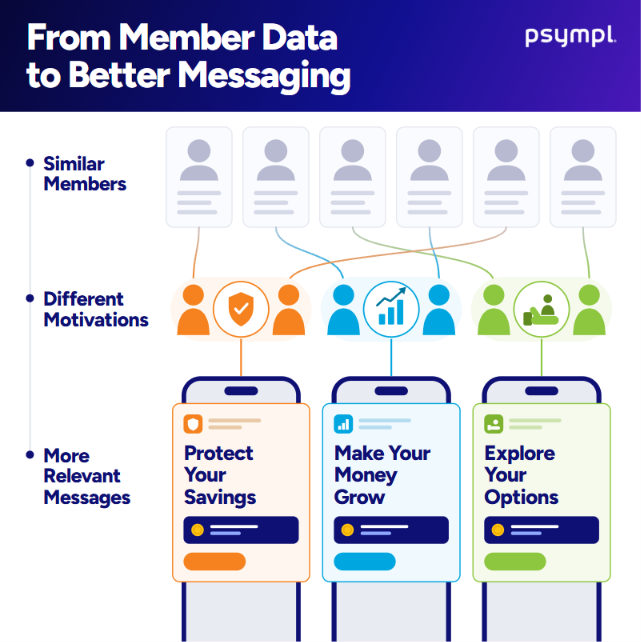
Who your customers are, where they live, what they do for work: these are all demographic data points which can group your customers together, but customers don’t make decisions in demographic groups. The drivers of individual decision making are analyzed through psychographic data: the beliefs and motivations behind each purchase and interaction. Psympl’s guide to bank customer segmentation shows how psychographic segments layer onto the demographic and behavioral data an institution already holds.
A credit union test shows the effect of segmenting beyond demographics:
FreeStar Financial Credit Union’s High Yield Savings campaign used psychographically-informed audiences in a 10,000 prospect test built from Experian Marketing Attributes and scored by Psympl, and it generated more than $1.2 million in new deposits while the traditional control group opened no new accounts.
Psympl turns this into practice with six tools:
1. Motivation Decoder™ (a short survey that assigns a segment)
2. Motivation Auto-Decoder™ (assigns segments across a member or prospect list using Experian data, which makes segmentation scalable)
3. Consumer Console™ (segment research and geotargeting)
4. Psymplifier™ (segment-specific content)
5. Psymplifier™ Extension (evaluates existing copy)
6. Sales Extension (adds motivation context to contact records)
6 Member Engagement Tactics Credit Unions Can Launch Now

These six tactics have a relatively low barrier to entry and do not require a long campaign. Segmenting your CRM by motivation shows which members to start with and what each is likely to respond to.
1. Hyper-local content members recognize
Community engagement separates a credit union from a national bank, and local content such as event recaps, neighborhood business spotlights, and branch staff stories shows it. CuCurator, a marketing platform built specifically for credit unions, added hyper-local post ideas and a monthly step-by-step playbook to its 2026 marketing calendar.
2. Referral programs with values-matched incentives
Referral programs pay out only when a new member is finalized, which can make them cheaper per member than wide-reach campaigns, according to Web Finance Direct. Matching the incentive to what a segment values, such as a donation to a local cause or a cash bonus, gives each group a reason to share.
Moreover, certain psychographic segments are more likely to be peer influencers and chat-leaders, so cultivating brand ambassadors among these segments heightens the likelihood of success.
3. Life-event triggered outreach
A move, a mortgage inquiry, or a new direct deposit creates a financial need, and a well-timed email or direct mail piece can meet it. B2E Data names new movers and likely banking switchers among the audiences credit unions can target, and notes that closed-loop attribution can tie an ad to a new membership, account opening, or loan application.
4. Short-form video from real staff
Members search on YouTube, Instagram, and TikTok as well as Google, and Consumers Credit Union’s 2025 marketing trends post describes SEO shifting toward what marketer Neil Patel calls “search everywhere optimization.” A two-minute video of a loan officer explaining how pre-approval works gives a credit union searchable content and a face members recognize.
5. Interactive financial education tools
Members already trust their institution as a teacher: 68.3% of account holders would trust their primary bank or credit union to provide free financial education, ahead of nonprofits at 35.4% and federal agencies at 34.0%, per the CFPB survey. Calculators, budgeting quizzes, and a first-home readiness checklist put that trust to work and show you what each member is planning for.
6. Email that reads like a conversation
Email receives about 12% of bank and credit union marketing budgets (ninth among channels), yet 48% of executives name it the strongest ROI channel, per Cornerstone Advisors. Write each send like a note from a staff member who knows the member’s situation, with one clear action and a sender members can reply to.
Match Your Biggest Challenge to the Tactic to Test First
The six tactics are not equal for every credit union. Match your first test to your most pressing problem and measure it by the outcome in the last column.
|
Primary challenge |
Tactic to test first |
Evidence from this article |
Success metric |
|
Low awareness among Gen Z and Millennials |
Plain-language member ownership message plus short-form video |
In DCU’s survey, the share likely to consider joining rose from 33% to 59% after respondents learned the benefits |
Qualified applications from those pages |
|
High acquisition cost |
Referral program with a values-matched incentive |
Referral rewards are paid only when a new member is finalized (Web Finance Direct) |
Cost per funded account |
|
Weak onboarding conversion |
Mobile-first application fixes |
3.36 applications are abandoned for every checking account opened online (Cornerstone) |
Application completion rate |
|
Low engagement with existing members |
Email written like a conversation, triggered by life events |
Email gets about 12% of budgets, yet 48% of executives name it the strongest ROI channel (Cornerstone) |
Product adoption and retention |
|
Results you cannot trace |
Closed-loop attribution |
Nearly 6 in 10 executives say their core or CRM system limits ROI measurement (Cornerstone) |
Funded accounts by source |
How Credit Unions Can Use AI Without Losing the Personal Touch
When applied properly, AI-powered tools can reduce a significant degree of the monotony and repetition in credit union marketing, allowing the staff to focus on refining the judgment, relationships, and local knowledge that members rely on a credit union for. Marketing is already the most common area where credit unions use generative AI, at 37%, ahead of lending at 23%, per the FinXTech survey of 52 senior technology executives.
The table below splits common marketing tasks into what AI handles, what your team keeps, and the safeguard that protects the personal touch. Psymplifier™ follows the same pattern: it generates segment-specific drafts, and staff review them before anything reaches a member. It integrates with and enhances an existing CRM and marketing platform instead of replacing them.
|
Marketing Task |
What AI Handles |
What Your Team Keeps |
Personal Touch Safeguard |
|
Email and campaign drafts |
First drafts, subject line variations |
Final edits, brand voice, compliance review |
Every message gets a human read before it sends |
|
Member segmentation |
Sorting members by behavior, life stage, and motivation (psychographics) |
Choosing which segments fit the credit union's mission |
Segments describe tendencies, not certainties, and compliance reviews credit-offer audiences for fair lending, even when segments stay out of underwriting |
|
Message personalization |
Adjusting tone and wording for each segment |
Approving messaging and testing it with real members |
Local language and stories stay in the copy |
|
Chatbots and virtual assistants |
Routine questions such as hours, rates, and card status |
Complex, sensitive, or emotional conversations |
Clear handoff to a staff member at any point |
|
Life-event outreach |
Flagging triggers such as a mortgage inquiry or a new direct deposit |
Reaching out in a personal, well-timed way |
A person, not an automated message, makes the first contact (within your data-use and opt-out rules) |
|
Content for AI search |
Structuring rate pages and FAQs for clear answers |
Fact-checking, local expertise, keeping content current |
Content reflects real branch knowledge |
|
Campaign reporting |
Summarizing results and spotting patterns |
Interpreting findings and setting budget |
Member feedback supplements the dashboards |
Curious Which Motivations Drive Your Members' Choices?
Even a credit union with detailed demographic or behavioral segmentation is bound to have a different mix of motivations among its members within those particular segments. That mix decides which message, offer, and channel works for each household, but without insight into those motivations, you’ll be firing blind. Psympl’s Motivation Decoder™ and Motivation Auto-Decoder™ identify those motivations through a short survey or by matching your member list against Experian data.
See which segments make up your membership and what each one responds to. Reach out now to talk through how a psychographic read of your members would fit your current campaigns.
Membership Growth Has an Age Problem: Reaching Gen Z & Millennials

Credit unions are facing an aging problem: they’re significantly more popular with older demographics than younger ones.
In CUCollaborate’s 2026 consumer perception survey, they found that only 63% of Gen Z hold a positive impression of credit unions, compared to older generations at 81%. Sogolytics, a survey software company, found that Millennial credit union membership fell from 31% in 2023 to 22% in 2025.
The members credit unions already have are older, so growth depends on reaching the newest adults.
1. Closing the awareness gap
In DCU’s 2025 Gen Z Banking Habits Survey of 1,298 respondents aged 13 to 28, 33% could not name any of the credit union benefits listed, per the DCU report. Citizens Equity First Credit Union reached Gen Z on TikTok, Instagram, Twitch, YouTube, and ESPN+, paired with athlete partnerships and on-campus education, and gained 1,800+ new Gen Z members, according to Filene.
2. Explaining member ownership in plain language
After DCU’s respondents learned about credit union benefits, the share extremely or very likely to consider joining rose from 33% to 59%. Say what member ownership means in one plain sentence and put it where younger prospects first land, such as the homepage and the account-opening page.
3. Mobile-first onboarding
For every checking account opened online, 3.36 applications are abandoned, according to Cornerstone Advisors’ 2026 Digital Banking Performance Metrics report. Fewer form fields, mobile-friendly document upload, and a saved-application reminder are user-friendly fixes to test first.
4. Starter products and fee-free checking
Sogolytics’ survey found that 85% of Millennials and Gen Z would consider a youth-focused account. Starter accounts and fee-free checking give younger prospects a low-commitment entry point and give the credit union a reason to start the relationship before they borrow.
5. Purpose-driven community messaging
Two-thirds of Millennials and Gen Z say they try to support brands aligned with their values, but only 35% feel their financial provider reflects those values, per Sogolytics. Show the values through specifics such as local scholarships, community grants, and financial education programs, because community involvement builds trust and credibility when members can see it.
6. Segmenting members by motivation within each generation
Generational labels group people by birth year, and psychographic segment distribution varies widely inside each generation. In Psympl’s national research, the largest psychographic segment holds about a third of Gen X, so a message built for it misses roughly two-thirds of the generation.
7. Maintaining Trust With Descendants
The stakes rise with the Great Wealth Transfer. Cerulli Associates projects $124 trillion in U.S. wealth transfers through 2048, and it has found that more than 70% of heirs are likely to fire or change financial advisors after inheriting. That research covers advisor relationships, and Psympl sees a parallel risk for credit unions, because loyalty to a parent’s institution does not pass to heirs automatically.
Credit unions that learn each heir’s motivation before assets move (and build the relationship through messages and offers that fit it)are better placed to keep those deposits. Motivation Auto-Decoder™ assigns segments across a member list, so a credit union can see its motivation mix before the transfer begins.
8 Quick Answers for Credit Union Marketing Teams
The market is changing constantly, so getting ahead is complicated and requires significant effort, but strong planning can make it that much smoother. Before you get started on adjusting your strategies, here are a few final questions we can get out of the way from the very beginning
1. How much should a credit union spend on marketing?
More than half of institutions set their marketing budget by adjusting the previous year’s figure, and financial institutions spend about 0.10% of assets on marketing, per Cornerstone Advisors’ Marketing ROI Gap report. Psympl recommends building the budget from the return you expect on each campaign, such as cost per funded account or loan, and using last year’s spend only as a reference point.
2. How can a small credit union compete with a limited budget?
Credit unions with falling membership tend to be small, and over half had less than $50 million in assets in Q2 2026, according to the NCUA. Platforms built specifically for credit unions help small teams cover the basics: CuCurator provides ready-to-edit campaigns, compliance-friendly templates, and a monthly step-by-step marketing playbook, and it reports members ranging from $15 million to over $2.5 billion in assets.
3. Which metrics should credit union marketers track?
Ron Shevlin of Cornerstone Advisors, speaking about digital banking, says a metrics framework should put “measurement on outcomes, not just activity,” which for marketing means tracking funded accounts, loan applications, and product adoption alongside clicks and opens. Psympl recommends reporting engagement, conversion, and product adoption by psychographic segment so you can see why a campaign worked, not only whether it did.
4. How long does it take for marketing efforts to show results?
In Psympl’s experience, many institutions see directional results within one to two campaign cycles, and larger shifts in retention or cross-sell show up over two to three quarters. Email and offer tests read faster, as in the 14-day Michigan State University Federal Credit Union test, while account and loan growth takes longer to appear.
5. Where does a psychographic platform fit alongside an agency or in-house team?
A psychographic platform adds segment data and segment-specific content to the CRM, email platform, and team a credit union already has, including in-house marketers, agencies, and fractional CMOs. In the FreeStar Financial engagement, Psympl scored the audiences while campaign execution came from MarketMatch, a Psympl agency partner.
6. How often should a credit union marketing plan be reviewed?
Psympl recommends reviewing campaign results by segment on a regular cadence and revisiting psychographic profiles at least annually, since life events such as marriage, inheritance, or retirement can shift a member’s profile. Psympl also recommends refining or retiring segments that stop producing results rather than keeping them out of habit.
7. Can psychographic segmentation work for business members?
Psychographics can apply to business members, but scaling is limited because Experian data matches consumers by name and home address, and national data compilers typically do not track people by work address. The practical route is a survey completed by the business member, which may not be feasible at volume.
8. How is marketing a credit union different from marketing a bank?
Credit unions are member-owned cooperatives, and consumers rate them accordingly: a poll commissioned by America’s Credit Unions and conducted by Frederick Polls and Harper Polling found a 73% favorable rating for credit unions versus 56% for large national banks, with gaps of +17 on trust and +16 on community connection. Field of membership also shapes targeting, since a regional credit union can focus spend on households inside its field of membership, as B2E Data describes for addressable TV.
Ready to Put Psychographics Behind Your Credit Union's Marketing Efforts?

Marketing channels and tools will keep changing, but every member still wants a good deal, and each one defines a good deal differently. That difference in motivation decides which message and offer a given member responds to. Psympl’s Psychographic AI™ platform is built for consumer financial services, combining segment data from Experian with tools that turn each segment into messaging.
Contact us to see which motivation segments make up your membership and how each one responds to your current offers. We will walk through what a rollout could look like for your credit union’s size and goals.

Brent N Walker
Table of contents