_TAG_2026.webp?width=1500&height=215&name=PSYMPL_LOGO_(R)_TAG_2026.webp "PSYMPL_LOGO_(R)_TAG_2026")















Table of contents

.svg)
The largest intergenerational transfer of assets in history is underway, with an estimated $124 trillion expected to change hands through 2048. Personalization based on individual values and financial psychology, not age-based assumptions, will determine which wealth managers retain existing client assets and capture new clients during this transition. Traditional demographic segmentation strategies are proving inadequate as younger inheritors and women taking on larger financial roles seek advisors who understand their unique perspectives on wealth.

The Great Wealth Transfer presents both opportunity and risk for financial advisors who must now serve multiple generations simultaneously. Many firms rely on generational stereotypes to guide their client engagement, but this approach overlooks the significant psychographic variation within each age cohort. Two Millennials may have vastly different risk tolerances, investment philosophies, and definitions of financial success despite sharing a birth year.
Understanding how different personality types and value systems shape financial decision-making offers a more reliable framework than age alone. Planning is becoming more personalized as clients increasingly demand that their financial strategies align with their personal values and goals. Wealth managers who adopt psychographic segmentation can deliver tailored experiences that resonate with individual clients regardless of generation.
The $124 Trillion Great Wealth Transfer Is Already Underway

Wealth management firm Cerulli Associates estimated that $124 trillion worldwide will be handed over through 2048. This massive intergenerational shift, known as the Great Wealth Transfer, is not a distant future event. It's happening right now.
Key distribution highlights:
- Over the next quarter-century, Millennials will receive $45.6 trillion while Gen X gets $39 trillion
- More than half of the total amount comes from high-net-worth and ultrahigh-net-worth individuals
- Approximately $18 trillion is expected to go to charity
- Among billionaires specifically, about $6.9 trillion will transfer by 2040
The transfer has already increased the number of multigenerational billionaires to 860, who collectively hold $4.7 trillion in assets. This represents growth from 805 billionaires with $4.2 trillion in 2024.
Financial institutions recognize that establishing relationships with women and next-generation clients positions them for success. Studies indicate that women will inherit a disproportionately large portion of this wealth, creating new dynamics in wealth management.
Why Generational Stereotypes Fail Wealth Managers

Wealth managers often rely on broad generational labels to segment clients, but this approach misses critical individual differences. A 35-year-old Millennial tech founder has vastly different needs than a 35-year-old teacher, regardless of their shared generation.
Psychographic factors like risk tolerance, values, and life circumstances matter more than birth year when creating effective wealth strategies. Two Gen Z inheritors might prefer completely different communication styles and investment approaches based on their personal experiences and financial goals.
Key Problems with Stereotype-Based Strategies:
- Assumes all members of a generation share identical preferences
- Ignores individual wealth backgrounds and financial literacy levels
- Overlooks varying comfort with technology within age groups
- Fails to account for different family dynamics and relationship structures
The data shows inheritance patterns are complex and individualized. Some Baby Boomers plan to spend their wealth entirely, while others prioritize leaving substantial legacies. Meanwhile, younger inheritors range from financially sophisticated investors to those completely unprepared for wealth management responsibilities.
Wealth managers who apply blanket assumptions risk alienating clients who don't fit the mold. A Millennial inheritor managing family real estate needs different guidance than one receiving liquid assets, even if marketing materials suggest they should want the same digital-first experience.
What Actually Drives Client Needs:
- Current financial situation and liquidity
- Career stage and income stability
- Family composition and obligations
- Personal values around wealth preservation
Effective personalization requires understanding each client's unique situation rather than defaulting to generational expectations.
Psychographic Differences Across Generations
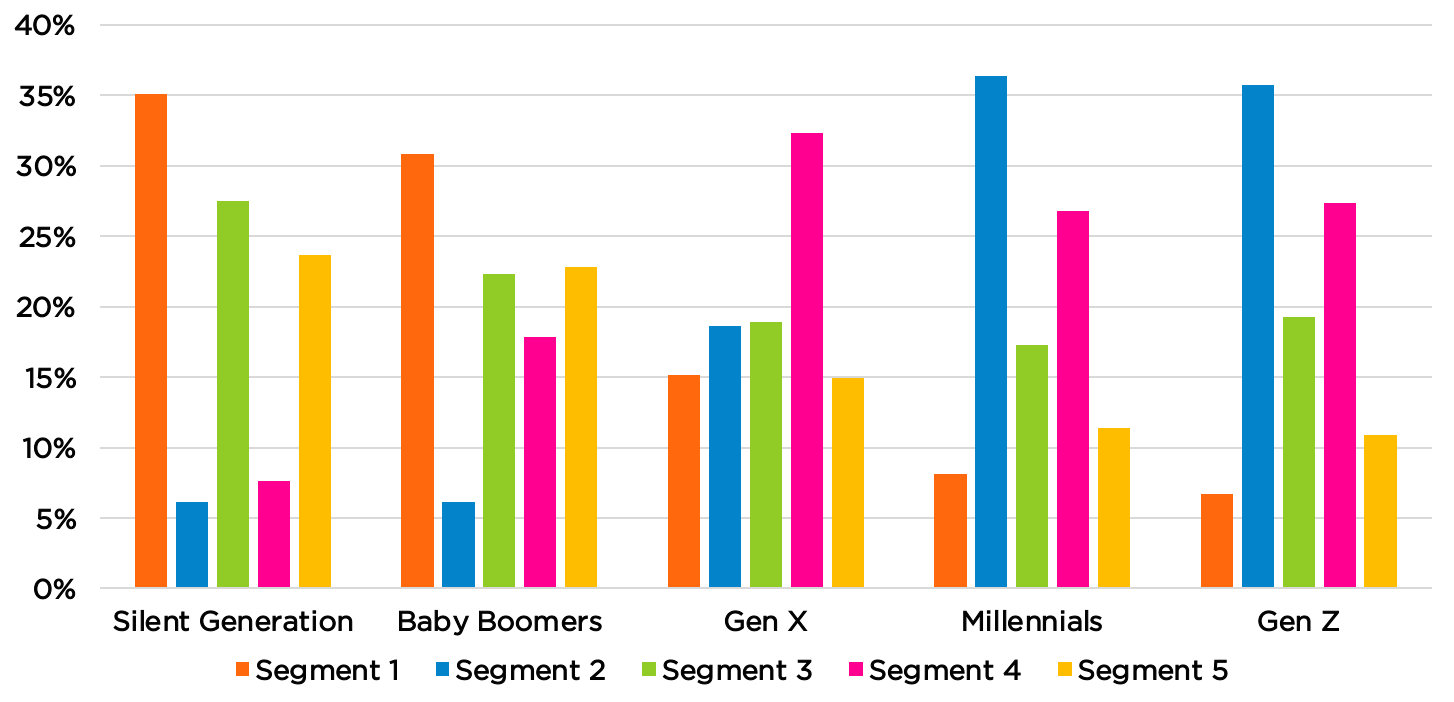
Financial decision-making patterns vary more by psychological mindset than by birth year. Psychographics pertain to people’s attitudes, values, fears, personalities, and lifestyles, which are core to their motivations and priorities. Gen X represents the most immediate AUM inflection point yet exhibits the widest psychographic variation among all cohorts receiving transferred wealth.
Using nationally-representative market research conducted with Ipsos, Psympl identified five distinct financial psychographic segments, each with a unique approach to investing and finances. Importantly, each financial psychographic segment requires different engagement and marketing approaches. While Psympl has extensive data and insights into each financial psychographic segment, a simplified description of each segment includes:
- Segment 1: Safety oriented, relies on financial experts
- Segment 2: Confident, self-directed, higher risk
- Segment 3: Balanced, long-term focused
- Segment 4: Anxious, resource-constrained
- Segment 5: Independent, low-complexity
Psychographic Segment Distribution Across Generations
Silent Generation & Baby Boomers
Baby Boomers control the majority of assets being transferred in the $124 trillion wealth shift occurring over the next two decades. This generation typically values personal relationships with advisors and prefers face-to-face communication over digital channels.
Their financial psychographics often emphasize stability and preservation rather than aggressive growth. Many developed their investment philosophy during periods of economic expansion and market volatility that shaped their risk tolerance.
The Silent Generation and older Boomers tend to trust established institutions and favor traditional investment vehicles. However, their heirs frequently hold different psychographic profiles that influence how they perceive risk, value guidance, and make decisions about inherited assets.
Generation X — The Immediate AUM Battleground
Generation X currently receives the largest volume of transferred assets but shows significant psychographic diversity within the cohort. Nearly half of advisors view The Great Wealth Transfer as an existential threat driven by poor retention rates among inheritors, and this concern is well-founded if they engage members of Gen X the same way they do their Boomer parents.
This generation spans early adopters of technology and those who prefer traditional advisory relationships. Their financial decision-making varies widely based on individual psychological factors rather than shared generational characteristics.
Key psychographic variations include:
- Different comfort levels with self-directed investing versus full-service advisory
- Divergent views on risk management and portfolio diversification
- Varied preferences for communication frequency and channel selection
- Distinct attitudes toward values-aligned investing and philanthropy
More than 40% of advisory relationships turn over when Gen X inherits assets from their parents. This transition reveals the inadequacy of demographic segmentation alone in predicting client behavior and retention.
Millennials & Gen Z — Growth, Values, And Digital Expectations
Younger generations demonstrate distinct psychographic profiles around values alignment and transparency. Their financial decisions often reflect personal beliefs about environmental impact, social responsibility, and corporate governance.
Digital-first communication preferences dominate but mask underlying psychographic differences in how they want to engage with financial institutions. Some seek extensive guidance while others prefer minimal intervention with portfolio management.
Values-aligned investing and philanthropy decisions vary sharply by psychographic segment rather than generation alone. Two Millennials with similar net worth may have completely different expectations for advisor involvement, risk tolerance, and investment priorities.
These cohorts expect personalized experiences that reflect their individual financial mindsets. Generic generational messaging fails to address the psychological factors that actually drive their engagement and loyalty to financial advisors.
What This Means For Asset Retention And New Client Acquisition
The Great Wealth Transfer presents a critical challenge for client retention in wealth management. irms must focus on re-winning business with inheritors to maintain those assets.
Personalization directly impacts both sides of practice growth. Client acquisition and retention represent distinct but connected strategies for financial advisors. Acquisition targets new prospects through marketing and outreach, while retention keeps existing clients engaged and loyal.
Key impacts on retention:
- Tech-savvy heirs expect personalized "know me" service as standard
- 64% of Millennials will pay premium fees for tailored investment advice
- Firms using personalized approaches see approximately 20% higher client retention rates
Key impacts on acquisition:
- Differentiation in a saturated market through investor-centric dialogue
- Enhanced visibility and relevance with younger demographics
- Stronger referrals from satisfied existing clients
Personalization transforms marketing efforts from generic activities into meaningful conversations with prospective inheritors. When wealth managers deliver experiences that reflect individual goals and preferences, they build the trust necessary to retain transferred assets.
The firms that embrace data-driven personalization position themselves to compete effectively for both inherited wealth and new client relationships. This approach allows advisors to demonstrate value to next-generation clients who might otherwise move assets to digital-native competitors or larger institutions.
How Psympl Helps Wealth Managers Win The Great Wealth Transfer
Psympl provides a psychographic intelligence platform specifically designed for financial services firms navigating the wealth transfer. The platform uses Psychographic AITM to identify five distinct financial mindsets that transcend generational categories and demographic assumptions.
The system integrates with existing data and MarTech stacks to enable what Psympl calls persuasive personalization at scale. This approach moves beyond traditional age-based segmentation to understand how different clients think about money, perceive risk, and make financial decisions.
Key capabilities include:
- Psychographic segmentation that reveals client motivations and values
- Adaptive communication tailored to individual decision-making styles
- Scalable personalization across client portfolios
- Psychographic Geo-targeting and heatmapping tools to identify prospect opportunities
The platform's financial psychographic model was developed through research conducted in collaboration with Ipsos. It addresses a critical problem: more than 40% of advisor relationships turn over among inheritors, even when heirs have similar balance sheets to their parents.
Psympl helps firms identify psychographic mismatches between current clients and next-generation decision-makers before assets transfer. This intelligence allows wealth managers to adjust their communication strategies, service models, and engagement approaches for each unique financial mindset.
The platform enables institutions to retain assets by understanding how people think about wealth rather than just how much they have. Firms gain insights into preferences around values-aligned investing, philanthropy, and guidance levels that vary by psychographic segment rather than generation alone.
The Future Of Wealth Management Is Psychographic
The wealth management industry stands at a critical juncture as an estimated $84 trillion to $124 trillion shifts from Baby Boomers to the next generation over the coming decades. Traditional demographic segmentation no longer provides the depth needed to retain relationships and assets during this transition.
Psychographic intelligence reveals how clients actually think about money, risk, and financial decisions—factors that vary dramatically even within the same age group or wealth bracket. Research shows that more than 40% of advisor relationships end when assets transfer to heirs, largely because firms assume demographic similarities translate to behavioral alignment.
Gen X represents the most immediate inflection point for AUM retention, yet this generation exhibits the widest variation in financial mindsets. Age-based strategies fail to account for the psychographic differences that drive engagement, trust, and decision-making patterns.
Financial institutions now need to shift from single-generation asset management to multi-generational relationship management. This approach requires understanding:
- How different individuals perceive risk and opportunity
- What communication styles resonate with specific financial mindsets
- Which values drive investment and philanthropic decisions
- How much guidance each client segment actually wants
Psychographic models identify distinct financial mindsets that transcend generational boundaries. These insights enable firms to deliver personalized experiences at scale, matching communication and service models to the psychological drivers that influence behavior. The firms that master psychographic segmentation will capture relationships that competitors lose to oversimplified demographic assumptions.
Prepare For The $124 Trillion Shift
The Great Wealth Transfer is not a distant forecast. It is a $124 trillion transition already reshaping wealth management. Firms that rely on age-based segmentation and legacy engagement models risk watching assets walk out the door as wealth moves from Baby Boomers to Gen X, Millennials, and Gen Z.
The firms that will win this transition are those that understand not just who inherits, but why they make financial decisions. Psychographic insight is the difference between a transferred asset and a transferred relationship.

Download Psympl’s Great Wealth Transfer Whitepaper to explore the data, generational psychographic differences, and strategic roadmap needed to protect and grow AUM.
Then consider partnering with Psympl to activate psychographic personalization across your CRM, marketing, and advisor engagement strategy. Because in the largest wealth transition in history, relevance is retention, and motivation drives growth.

Brent N Walker
Table of contents