_TAG_2026.webp?width=1500&height=215&name=PSYMPL_LOGO_(R)_TAG_2026.webp "PSYMPL_LOGO_(R)_TAG_2026")















Table of contents

.svg)
Wealth transfer ancillary services are specialized support offerings that extend beyond basic estate planning and asset distribution to help families navigate the emotional, educational, and strategic complexities of passing wealth between generations. These services include family governance counseling, next-generation education programs, philanthropic planning, tax optimization strategies, and ongoing communication frameworks. As Baby Boomers prepare to transfer an unprecedented amount of wealth to their heirs, financial institutions face a critical challenge in retaining assets that often leave with the inheritors.

The $124 trillion intergenerational wealth transfer currently taking shape represents both an enormous opportunity and a significant retention risk for wealth management firms. Traditional approaches that focus solely on the technical aspects of transferring assets frequently fail to build relationships with the next generation. When inheritors receive wealth without meaningful connections to their parents' advisors, they typically move their assets elsewhere within months of inheritance.
Firms that integrate ancillary services into their wealth transfer strategies create deeper relationships with entire family systems rather than individual clients. By addressing the full spectrum of needs surrounding inheritance—from preparing children to understand wealth responsibly to aligning family members on philanthropic goals—advisors position themselves as indispensable partners across generations. This holistic approach transforms wealth transfer planning from a one-time transaction into an ongoing advisory relationship that naturally extends to heirs.
The Loyalty Risk Hidden Inside the $124 Trillion Wealth Shift

The $124 trillion wealth transfer through 2048 presents a critical challenge for financial institutions beyond asset management alone. The real risk lies in customer retention as $105 trillion flows to heirs who may not share their parents' banking relationships.
Key Transfer Breakdown:
- $105 trillion to heirs
- $18 trillion to charitable causes
- $100 trillion from Baby Boomers and older generations (81% of total transfers)
Financial institutions face deposit account loyalty challenges as inheritors receive assets. Younger generations typically maintain different banking preferences and digital expectations than their predecessors. Many have established relationships with fintech platforms or competitors before receiving inherited wealth.
This transition isn't merely about money changing hands. The wealth transfer includes a shift in values, expectations, and brand loyalty that requires institutions to adapt their service models.
Primary Loyalty Risks:
- Heirs switching to preferred financial providers after inheritance
- Generational differences in service expectations
- Competition from digital-first platforms
- Lack of existing relationships with inheritors
Banks and credit unions must engage beneficiaries before asset transfers occur. This proactive approach requires identifying account holders' heirs and building relationships with them independently. Institutions that wait until after the transfer often lose both the assets and the relationship to competitors who have already established trust with the next generation.
What Are Wealth Transfer Ancillary Services?

Wealth transfer ancillary services encompass specialized professional support that addresses tax implications, legal structures, estate documentation, and financial coordination during the transfer of assets from one party to another. These services work alongside core wealth management to ensure compliance, minimize tax exposure, and protect asset value throughout the transfer process.
Tax Strategy & Coordination
Tax planning stands as a critical component when transferring wealth between generations or entities. High net-worth estates face federal estate taxes, and depending on location, state-level taxation that can significantly reduce the amount beneficiaries ultimately receive.
Professional tax advisors analyze current tax laws and identify strategies to reduce taxable estate values. They coordinate gift tax exemptions, annual exclusion limits, and generation-skipping transfer tax considerations. Many families benefit from structuring transfers over multiple years to maximize available exemptions.
Tax coordination also involves working with accountants and wealth managers to time asset transfers strategically. Capital gains considerations, income tax implications for beneficiaries, and the step-up in basis rules all influence when and how assets should transfer. Advisors must stay current with changing tax legislation that affects wealth transfer planning strategies.
Estate Planning & Trust Services
Estate planning documents form the legal framework for asset distribution according to an individual's wishes. Wills, trusts, powers of attorney, and healthcare directives establish clear instructions for asset management and distribution.
Trusts serve as foundational components in wealth transfer strategies for families seeking control over distribution timing and conditions. Revocable trusts provide flexibility and probate avoidance while maintaining control during the grantor's lifetime. Irrevocable trusts offer tax advantages and asset protection by removing assets from the taxable estate.
Specialized trusts address specific needs. Irrevocable Life Insurance Trusts remove policy proceeds from taxable estates. Qualified Personal Residence Trusts transfer real estate at discounted gift tax values. Each structure requires careful analysis to match family circumstances and goals.
Trust administration services ensure proper asset titling, compliance with trust terms, and accurate record-keeping throughout the trust's existence.
Legal & Structuring Support
Legal professionals draft and file documents that establish proper ownership structures and ensure regulatory compliance. They prepare trust agreements, transfer deeds, business succession documents, and beneficiary designations that align with the overall wealth transfer plan.
Business owners require additional legal support for entity structuring and succession planning. Buy-sell agreements, operating agreements, and shareholder arrangements need coordination with personal estate plans to avoid conflicts or unintended tax consequences.
Legal advisors also address asset protection concerns through proper entity selection and titling. They structure ownership to shield assets from creditors, lawsuits, or marital disputes while maintaining the ability to transfer wealth efficiently. Coordinating state-specific laws becomes essential for families with property or beneficiaries in multiple jurisdictions.
Accounting & Cash Flow Advisory
Accounting professionals track asset values, prepare tax returns, and maintain financial records throughout the wealth transfer process. They document basis calculations, track gift tax exemption usage, and prepare estate tax returns when required.
Cash flow analysis helps families understand liquidity needs during and after wealth transfers. Estate settlement costs, ongoing trust expenses, and potential tax liabilities require adequate liquid assets. Accountants project these needs and recommend funding strategies.
Beneficiary financial education often involves accountants explaining tax implications of inherited assets. Different asset types—retirement accounts, real estate, investment portfolios—carry distinct tax treatments that affect beneficiaries' financial planning decisions. Regular financial reporting keeps all parties informed about trust performance and distributions.
Why Ancillary Services Drive Inheritor Retention
Wealth transfer creates a critical moment when inheritors decide whether to maintain existing advisory relationships or seek new ones. Ancillary services address specific generational needs and psychological factors that influence this decision, making retention rates significantly higher when firms provide comprehensive support beyond basic asset management.
Different Generations, Different Motivations
Baby Boomers inheriting wealth typically value services that preserve capital and generate reliable income streams. They respond to ancillary offerings like estate planning coordination, tax optimization strategies, and charitable giving structures that align with their established financial priorities.
Generation X inheritors focus on balancing multiple financial obligations simultaneously. They benefit from ancillary services, including college funding strategies, small business succession planning, and integrated debt management approaches that address their sandwich generation responsibilities.
Millennials and Gen Z inheritors prioritize values-based investing and digital accessibility. These generations seek ancillary services such as impact investing guidance, cryptocurrency integration, ESG portfolio alignment, and mobile-first communication platforms that match their technological expectations and ethical considerations.
Firms offering age-appropriate ancillary services demonstrate understanding of each generation's unique circumstances. This targeted approach creates stronger advisory relationships than generic wealth management alone.
The Psychographic Loyalty Equation
Inheritors experience emotional vulnerability during wealth transfer periods, making psychographic factors more influential than demographics alone. Ancillary services that address anxiety, uncertainty, and decision fatigue create psychological safety that strengthens advisor-client bonds.
Key loyalty drivers include:
- Proactive education: Financial literacy programs and inheritance workshops reduce inheritor stress
- Family mediation: Conflict resolution services prevent relationship damage during estate settlements
- Legacy planning: Services helping inheritors define personal values and philanthropic goals
- Holistic coordination: Integration with legal, tax, and insurance professionals eliminates fragmented experiences
Inheritors who receive comprehensive support develop stronger emotional connections to their advisory firms. They perceive these relationships as partnerships rather than transactional arrangements, reducing the likelihood of switching providers after receiving their inheritance.
The combination of practical assistance and emotional support creates a retention advantage that exceeds 70% compared to firms offering asset management alone.
Moving From Transactional to Holistic Relationships
The wealth management industry is experiencing a fundamental shift in how advisors engage with clients during wealth transfers. Traditional transactional models that focus solely on investment returns no longer meet the expectations of modern investors and their families.
Advisors who humanize their approach by focusing on values, vision, and goals create deeper relationships that extend beyond basic asset management. This transition requires professionals to understand the complete financial picture of their clients.
Key Components of Holistic Engagement:
- Tax optimization and strategic planning
- Estate management and legacy considerations
- Healthcare and insurance coordination
- Family governance and communication
- Intergenerational relationship building
McKinsey analysts suggest that modern financial advisors function more like integrated life and wealth coaches who address investments, banking, healthcare, protection, taxes, estate needs, and broader financial wellness. This comprehensive approach transforms advisors into indispensable strategic partners.
The shift toward family wealth services offers investors a more holistic approach to managing increasingly complex portfolios and wealth transfers. Firms that adopt this model position themselves to capture multi-generational relationships rather than simply managing a single transaction.
Advisors implementing holistic strategies address the entirety of their clients' financial, business, and personal lives. This comprehensive engagement creates what industry experts call a "digital moat" that enhances competitive positioning through trust and expanded family influence.
Operationalizing Wealth Transfer Ancillary Services With Psychographic Intelligence
Financial institutions face significant challenges in retaining assets during the $124 trillion Great Wealth Transfer as wealth moves across generations. Traditional demographic segmentation fails to capture the nuanced preferences and communication styles of inheriting beneficiaries.
Psychographic intelligence enables persuasive personalization by analyzing values, attitudes, and decision-making behaviors rather than relying solely on age or income brackets. This approach allows wealth managers to tailor ancillary services to individual client motivations.
Key operational applications include:
- Estate planning communication tailored to risk tolerance and family dynamics
- Trust administration messaging aligned with beneficiary preferences
- Philanthropic advisory matched to personal values and causes
- Tax optimization presentations designed for specific comprehension styles
- Insurance coordination based on protection priorities
Understanding how psychographic differences shape investing, planning, and trust transforms service delivery from one-size-fits-all to individually relevant. Advisors can deploy these insights across client touchpoints, including onboarding, review meetings, and digital platforms.
Psympl collaborated with Ipsos to develop a financial psychographic segmentation model, which identifies the psychographic profile for any bank, wealth management, or financial services customer or prospect. Each psychographic segment approaches money, finances, and investing differently, with unique values, risk tolerances, goals, and involvement in managing their assets.
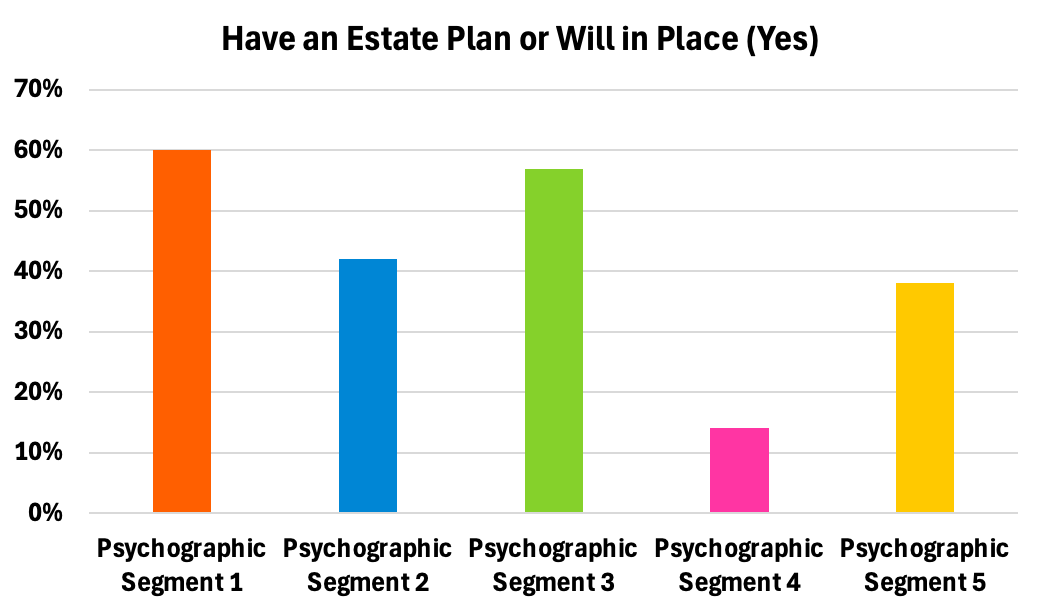
Psympl’s research explored whether certain financial psychographic segments represented greater opportunities for ancillary services. Regarding estate plans and wills, Psychographic Segments 1 and 3 are the most likely to have one in place, but these are only small majorities; more than 40% of these Psychographic Segments lack a will or estate plan. A minority of Psychographic Segments 2, 4, and 5 have an estate plan or will in place, with fewer than 1 in 5 members of Psychographic Segment 4 currently benefitting from this service.
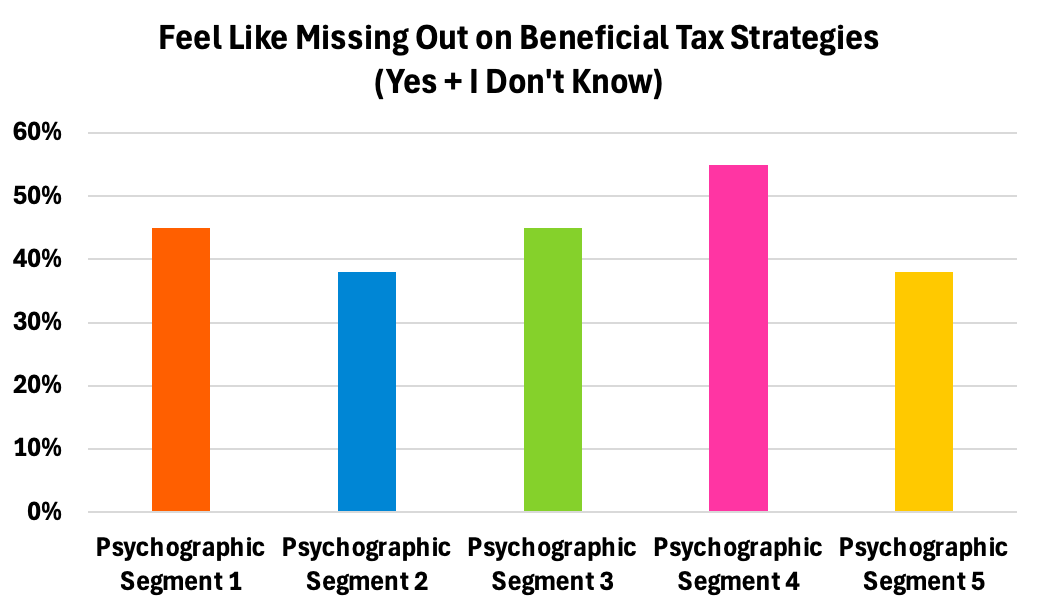
Tax strategies are also an ancillary service that can be highly beneficial for parents and their heirs, as many feel they are missing out - or don’t know whether they are missing out, representing an education opportunity.
These services can provide a strong bridge between generations, but a financial services firm needs to recognize that different psychographic segments require distinct engagement strategies to maximize effectiveness and build the strongest possible bridge.
The shift requires firms to implement psychographic assessment tools and integrate findings into client relationship management systems. Training programs must equip advisors to recognize psychographic indicators and adjust their service recommendations accordingly. This operational framework supports multi-generational relationship management rather than single-generation asset management strategies.
The Competitive Advantage of Integrated Wealth Transfer Ancillary Services
Financial institutions that integrate wealth management and trust services gain a strategic advantage in today's competitive market. Seven in ten younger customers prefer combining banking, trust, and wealth management relationships under one roof.
The traditional fragmented approach to wealth transfer creates friction for clients who must coordinate between multiple advisors and service providers. Wealth managers adopting a holistic approach can address political instability and market volatility concerns while expanding into ancillary services. This consolidation streamlines processes and allows for greater transparency across fee structures and advisor decisions.
Key advantages of integration include:
- Consolidated systems and harmonized data across all client touchpoints
- Enhanced advisor training to deliver comprehensive solutions
- Reduced operational complexity for both clients and institutions
- Improved ability to meet evolving needs of affluent clients
Wealth management firms that invest in technology, integration, and efficiency position themselves to compete effectively amid mergers and acquisitions, wealth transfers, and rising client expectations. The ability to offer fundamental ancillary services such as tax planning, legal advisory, and real estate consulting within an integrated framework differentiates leaders from competitors.
Institutions equipped with integrated service and operating models can accommodate a wide range of business strategies while maintaining process efficiency. This structural advantage becomes increasingly valuable as the complexity of client needs continues to grow.
Loyalty Is Built Before the Inheritance Arrives
Financial advisors and wealth management professionals face a critical window of opportunity that closes rapidly once assets transfer. Four out of five next-generation millionaires plan to replace their parents' wealth management advisor within one to two years of inheriting wealth. This statistic underscores a fundamental shift in how professional relationships form and persist across generations.
The convergence of changing HNWI loyalty trends means that waiting until assets change hands guarantees competitive disadvantage. Advisors must establish direct relationships with heirs while current clients remain active in the wealth management process.
Key actions that build pre-inheritance loyalty include:
- Requesting introductions during family financial assistance conversations
- Adapting communication methods to match generational preferences
- Providing holistic guidance on gift versus loan structures
- Facilitating multi-generational family wealth discussions
- Offering digital touchpoints and transparent portfolio access
The wealth transfer itself represents merely one transaction in what should be a decades-long advisory relationship. Professionals who position themselves as resources for entire families—not just individual account holders—create the foundation for retention before succession planning becomes urgent.
Ancillary services ranging from real estate guidance to debt management strategies provide natural entry points for engaging younger family members. These touchpoints demonstrate value beyond traditional portfolio management and establish credibility with heirs who evaluate advisors differently than their parents did.
Prepare for the Great Wealth Transfer with Psychographic Precision
The firms that protect and grow AUM during this historic shift will go beyond demographics and beyond portfolio management.

Download Psympl’s executive whitepaper, The $124 Trillion Great Wealth Transfer: Psychographics Are the Key to Protecting and Growing AUM Across Generations, to learn how psychographic intelligence and wealth transfer ancillary services can strengthen loyalty across generations.
Explore how partnering with Psympl can help your firm deliver persuasive personalization at scale — and turn generational risk into generational growth.

Brent N Walker
Table of contents